“Being an intellectual creates a lot of questions and no answers.”-Janis Joplin
My mom has long been one of my heroes (heroines?) and a champion of my creative impulses and flights of imagination. One of the earliest examples of her limitless support was the Fiddlesticks sets she bought me.

Here it is. The Knickerbocker Fiddlesticks World of Mazu building set. Been looking for it for about five years now. This is one of the earliest toys I can ever remember having.
Gaze upon this image and appreciate it. You don’t know what I had to do to get it. Well, okay, I actually just had to look it up on Google, but it was only after five years of searching for the set, in addition to another couple of nights looking for it again (due to the fact that, uh, I forgot what it was called). But MAN, that second search was ridiculous; there were virtually no pictures of the set anywhere on the net, no matter how many search terms I submitted. Eventually, I had to resort to looking in the one place I suddenly remembered the pic would be – on my Facebook page, where I posted it three years ago.
This is what happens when I put things away. I can never find them again.
The Knickerbocker Fiddlesticks sets were comprised of a series of multi-colored tubes, about the thickness of a #2 pencil, which varied in length, along with a variety of two-, three-, and four-pronged connectors for putting the tubes together. Every unit was packaged with larger, plastic shell pieces that allowed the builder to make various objects, from vehicles, to buildings, to otherworldly Lovecraftian horrors of gargantuan proportions. “Action” figures (they could bend over and sit down) were included with the sets. The Knickerbocker company had a long tradition of making toys from licensed characters, and they continued in that vein with several popular Marvel and DC superheroes, including Spider-Man and Superman. One side of the figures was decorated with decals, with the characters standing invariably with arms akimbo.

Above: A Batman set. I had that one too.
As my little brain grew more and more complex in its ability to comprehend and appreciate my toys, I began to realize that the Fiddlesticks World of Mazu set had a certain aspect to it that I hadn’t noticed in other building toys: you could build stuff with Legos and Lincoln Logs, but this thing was candy-colored conflict and excitement in one large box. On the one hand, you get two astronauts. On the other, you’re presented with an absolutely massive alien, the dimensions of which you, the builder, could dictate. Though it’s solid, intimidating face and clawed feet looked a bit incongruous when mounted on its skeletal rainbow body, for one of the first times in my young life I had been presented with a toy that contained both antagonist and protagonists (or vice-versa) in one package.
Being a child who enjoyed the simple narrative of good-vs.-evil, the two astronauts would always have to be on their guard from becoming a snack for the malignant Mazu (I don’t recall ever using that appellation, however. Prolly just called it ‘the monster’). For his part, Maz was no passive threat. He was packaged with two huge pincers that the builder could operate manually, trapping the perpetually-in-profile explorers and dragging them off to their doom. Sadly, it wasn’t in my nature at the time to spin an adventure wherein the obviously enraged Mazu was an innocent actor somehow being provoked by the astronauts, possibly bugged by their environmentally-destructive attempts to score some unobtanium or some such.
But it mattered little. What I had was a toy that allowed me, though I was unaware at the time, to explore my ever-growing love of speculative fiction and storytelling. This was a toy that I could build into almost literally anything I wanted (a spaceship could be constructed as well, as the packaging shows), with an obvious push towards the realm of the FAR OUT! If I wanted to follow the included instructions and build Mazu, or a starship, or just a plastic thingamabob from Fancyville, I was free to do so. It wasn’t the little white connectors that kept my creations together, it was my imagination.
And this was one of the many reasons why my mom was my hero. No matter what my report card may have said, no matter how unprofitable a future in being a chronicler of the impossible may seem, she never stopped feeding my imagination, never stopped inspiring me, pushing me, challenging me to consider things from different angles in order to become a better storyteller.
Between that, those wonderful memories of her showing me how to put Mazu together, and the tireless work she did to keep Mike and me rolling in toys to begin with (obviously having dealt with proper food, housing, and healthcare first), my mom enriched my life in ways I can’t begin to thank her for.
Nevertheless: Thanks, Mom.
This gallery contains 8 photos.
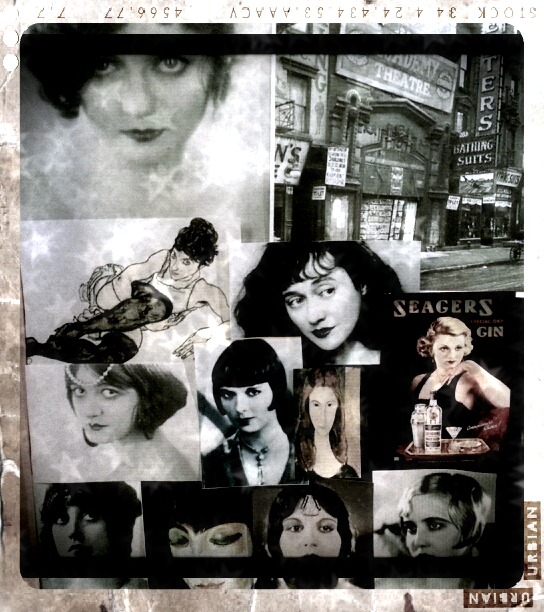
In my world, complex stories call for physical inspiration boards. The five-part short story I am writing has been in the planning stages for 3 years. In fact, the first part was written in January 2010. I’m finally ready to move ahead with the rest of the project (more details on that later). After completing it, I plan on adapting it into a play. Ambitious, much? Always! Before starting on the second segment, I decided it would be wise to pull together the disjointed bits of inspiration that have been living in my head for so many months. This collective of images lives on one of the glass blocks that divide my studio from the bedroom I share with The Chef. One glance to the left from where I type this, and ta-da!
I fancied up the photos so that you have a better idea of how things look inside my head!

Inspiration Board for Untitled Short Story
Yes, it is set in the 1920s. Why do you ask?

Inspiration Board, alternate treatment
I will add images to the board as needed.

Miles Davis Quote Poster

Henry Miller Quote Poster
And now, in the interest of public service, we present:
I baked my first cake from scratch when I was nine years old: a simple cocoa cake, round, one-layer. I decorated it by throwing a handful of confectioners’ sugar on top, the powder landing sparse and uneven in spots, heavy like a snowdrift in others. It was beautiful, and tasted like spongy hot chocolate. From that moment on, standing triumphantly in my aunt Lauree’s small kitchen, I had a new hobby.
I found my sole domestic comfort early, unless brewing a perfect pot of tea counts. To this day, I would rather write and read than do anything else. Baking is my only life-long hobby, the one non-verbal art I have never ignored or repudiated altogether. My favourite time to bake is in winter, when the cold starts pushing through the walls of even the most solid structure. I meet Jack Frost head-on, with a hot oven and a swirl of sugar and spices at the ready.
I’m in the habit of reading as I bake. Consuming a few sentences of Hardy or Plath or Trollope whilst blending cake batter or folding in nuts and sultanas is appropriately meditative for this most serene of the creative arts. The uncontrollable frenzy of the holidays officially starts in America on Thursday. The next month will be a kaleidoscopic whirl of shopping, parties, and working with all of my settings broken, but one: overdrive. A few hours spent baking cookies, bars, brownies, and pies will preserve my nerves and restore my balance close to something I can call normal.
I am dedicating today, the 18th of November, this lovely calm before the holiday storm, to Proust and his madeleines. I was born on Marcel Proust’s birthday, 10th July. Today marks the 90th anniversary of his death. He was 51 years old, and left some of the most lyrical, evocative, and intensely beautiful writing in literature. All of that, and an unbreakable association with French tea-cakes called madeleines? Delicious.
Madeleines require very few ingredients, are easy and quick to make, and can be adapted to fit your whimsies. As they are shaped like shells, they require a special but inexpensive tray, but if you are ambitious you could try shaping them by hand!
MADELEINE COOKIES
Ingredients (minus milk + a decorative pumpkin). Continue reading
Figuring out my audience while writing a young reader’s book.
#4
You know, I would’ve thought that the spirit-crushing doubt that one experiences while stitching up their monster of a writing project was the worst part of the creative ordeal. Turns out I was wrong. The trepidation that kicks in after you finish the first draft can be just as daunting.
Ever hurt yourself in one of those “Ssssssssssssst-OOH!!” kind of ways? Like, you’re shaving a part of your body that you can’t see all that well with a cheap “safety” razor, and then you zig when you should have maintained a nice, smooth, even zag? You hear that “KRTCH!!” of flesh being ripped open, that uncomfortably familiar feeling of something viscous and sticky running from some intimately internal place, and the reality-boggling pain of having shredded the skin off of an inconceivably tender area? If you haven’t, stop reading and go do it, and then you’ll know what I mean.
Arright, so now, you’re in this amazing amount of pain, and you know you’re bleeding. But do you look at it right away? Logically, you would – but there are many of those in this world [me] who would pause before taking a look at his handiwork. There’s something about not looking at the thing that somehow puts off the magnitude of what happened. If I don’t see it, it’s not as bad as it feels. Out of sight, somewhat out of mind.
Right now, I’ve put my story out of sight. I finished the first draft of The Princess Project one week ago (28 October), and I haven’t really looked back since. There’s something mildly unpleasant about reviewing the work I’ve done, as if doing so would show just how truly incompetent I am with the written word. You would think that not glancing back at the finished draft would be a comforting thing, but no – it really only serves to ramp up my sense of dread about what I’ll find when I double-click the file once more.
The theme of this post was going to be doubt, but I find there’s plenty of that to write about here just by thinking about what I wrote. The fear that I will inevitably be razzed for anything I put down is a powerful one, and it works on my whether I’m actually writing or not. I gotta find a way to get over it, to surmount this dread and move forward. It’s really not helping me meet my deadline at all.
KM Scott is an aspiring writer currently teaching English in South Korea. He is currently sweating over a young-reader’s book, the development of which he chronicles in this blog. Pray for him!
And now, in the interest of public service, we present:
Figuring out my audience while writing a young reader’s book.
#3
I’ve always felt that my writing process was akin to the evolution of living species on planet Earth: It is crushingly slow and a lot of things develop that are going to prove unnecessary to the success of the end product, kind of like having a second appendix. One of the things that causes me to drag my feet when getting something down on paper is the “incubation period”, the length of time that I let an idea marinate in my mind before trying to manifest it somehow.
This is where I heavily contemplate detailed elements of the idea, from character quirks to the history of the world the story is set in (the term “thorough daydreaming” would work as a good shorthand, except it’s longer). Normally I’m content to do this to a certain degree, so long as I’m actually producing something. Usually though, the truth is that the incubation period is criminally long in comparison to the production period. It is far easier to think about the story than actually work on it.
However, with this Princess Project that I’m working on, I haven’t allowed myself the luxury of time. I’ve a deadline now, and need to meet it if I’m going to reach my personal goals, not just as a writer, but as a teacher who wants to give his students a gift. That’s not to say that I haven’t gone whole days without writing a darn thing, but nonetheless, the level of dedication I feel that I’m supposed to have is admirable.
Having to work without an extended cooking time is an interesting [frustrating] experience. In truth, I’d come up with the idea several months ago, and so had plenty of time to think casually about the characters, technology, setting, et cetera. This, I found, was the easier part of the story to write. Those parts of the story that I hadn’t already envisioned were pretty easy to make up on the spot. From a technical standpoint, the writing wasn’t a problem.
The voice of the story, on the other hand, was another matter (I’m writing in the past tense here because I’ve finally gotten the first draft done HALLELUJAH). What I mean here is, what techniques should I use to tell the story? Should I use narrative tricks, employ ambiguity to inspire the imagination, be explicit in the detail of the narrative? What kind of language should I use? I mean, my main characters are royal princesses. Keeping my inscrutable audience of young readers (8-14, I guess) in mind, should I write down to what I would have to assume is their level, or should the ladies speak with a learned, scholarly, regal vocabulary?
And how do they speak to each other? The protagonists can be described as Z, the Leader, Ayomi, the Adventurous One, and Ballista, the Smart One Who Shoots Things. There are several different creative avenues to explore here. Should Z be pedantic and virtuous, as Leader heroines are often depicted as, or should she be sly and forward thinking? How exactly do I present Ballista as both a reserved bookworm and wisecracking action heroine at the same time? Does she actually crack wise, or does she make simple, somewhat philosophical statements that turn out to be witty one-liners when one sits and thinks about them?
There are two challenges here. First, I have to get the voices of the characters straight. I know who they are (roughly), I just need to develop how they sound. Second, I have to bring those voices together in harmony; establish how they contrast with each other, bounce ideas between each other, and finish each other’s sentences. In short, they need to become an old married couple (in an all-female, polygamous relationship way).
I find myself missing the incubation period. This would have been spent composing the music of the characters interaction. Sure, it would have taken a ridiculous amount of time, but I would’ve felt more comfortable going into the project. And yet, maybe comfort is not what I need here. Maybe I need to be a bit on edge here, unfettered by any sense of security, in order to challenge my limits and get my best work. This could be a perfect opportunity to train my brain to produce more over a far shorter period of time, which would be an excellent talent to bring into writing for television. Indeed, come to think of it, comfort only delays my desire to create.
I sure liked having it, though.
Next time: DOUBT.