The Dead Writers Round-Up: 21st-22nd November

  • Voltaire was born on 11/21/1694. “I hate women because they always know where things are.” (Candide)
  • Sir Arthur Quiller-Couch was born on 11/21/1863. “We make our discoveries through our mistakes: we watch one another’s success: and where there is freedom to experiment there is hope to improve.” (Oxford Book of English Verse, 1250-1900; On the Art of Reading)
  • Harold Nicolson was born on 11/21/1886. “We are all inclined to judge ourselves by our ideals; others by their acts.” (Paul Verlaine; Swinburne; King George V; The Age of Reason (1700-1789); Byron: The Last Journey)
  • Ellen Glasgow died on 11/21/1945. “All change is not growth, as all movement is not forward.” (Virginia; In This Our Life)
  • Robert Benchley died on 11/21/1945. “Behind every argument is someone’s ignorance.” (Pluck and Luck; Inside Benchley; Benchley Beside Himself)
  • George Eliot was born on 11/22/1819. “It is never too late to be what you might have been.” (Adam Bede; The Mill on the Floss; Middlemarch; Daniel Deronda)
  • Andre Gide was born on 11/22/1869. “There are very few monsters who warrant the fear we have of them.” (The Fruits of the Earth; The Immoralist)
  • Jack London died on 11/22/1916. “You can’t wait for inspiration. You have to go after it with a club.” (The Call of the Wild; The Sea-Wolf; White Fang; The Iron Heel; The People of the Abyss)
  • Aldous Huxley died on 11/22/1963. “After silence, that which comes nearest to expressing the inexpressible is music.” (Crome Yellow; Brave New World)
  • C.S. Lewis died on 11/22/1963. “You are never too old to set another goal or to dream a new dream.” (Mere Christianity; The Screwtape Letters; The Chronicles of Narnia)

[All images are in the Public Domain and our courtesy of Wikimedia Commons]

Baking Madeleines for Proust

I baked my first cake from scratch when I was nine years old: a simple cocoa cake, round, one-layer. I decorated it by throwing a handful of confectioners’ sugar on top, the powder landing sparse and uneven in spots, heavy like a snowdrift in others. It was beautiful, and tasted like spongy hot chocolate. From that moment on, standing triumphantly in my aunt Lauree’s small kitchen, I had a new hobby.

I found my sole domestic comfort early, unless brewing a perfect pot of tea counts. To this day, I would rather write and read than do anything else. Baking is my only life-long hobby, the one non-verbal art I have never ignored or repudiated altogether. My favourite time to bake is in winter, when the cold starts pushing through the walls of even the most solid structure. I meet Jack Frost head-on, with a hot oven and a swirl of sugar and spices at the ready.

I’m in the habit of reading as I bake. Consuming a few sentences of Hardy or Plath or Trollope whilst blending cake batter or folding in nuts and sultanas is appropriately meditative for this most serene of the creative arts. The uncontrollable frenzy of the holidays officially starts in America on Thursday. The next month will be a kaleidoscopic whirl of shopping, parties, and working with all of my settings broken, but one: overdrive. A few hours spent baking cookies, bars, brownies, and pies will preserve my nerves and restore my balance close to something I can call normal.

I am dedicating today, the 18th of November, this lovely calm before the holiday storm, to Proust and his madeleines. I was born on Marcel Proust’s birthday, 10th July. Today marks the 90th anniversary of his death. He was 51 years old, and left some of the most lyrical, evocative, and intensely beautiful writing in literature. All of that, and an unbreakable association with French tea-cakes called madeleines? Delicious.

Madeleines require very few ingredients, are easy and quick to make, and can be adapted to fit your whimsies. As they are shaped like shells, they require a special but inexpensive tray, but if you are ambitious you could try shaping them by hand!

MADELEINE COOKIES

  • 3 eggs
  • 3/4 cup sugar
  • 1 teaspoon vanilla
  • 1/3 cup milk
  • 2 cups flour
  • 1 teaspoon baking powder
  • 6 tablespoons butter, melted
  • the zest of 1 lemon

Ingredients (minus milk + a decorative pumpkin). Ingredients (minus milk + a decorative pumpkin). Continue reading

A Year in Books/Day 221: Bill Bryson’s Dictionary for Writers and Editors

  • Title: Bill Bryson’s Dictionary for Writers and Editors
  • Author: Bill Bryson
  • Year Published: 1991/This Edition: 2009 (Anchor Books)
  • Year Purchased: 2012
  • Source: The Book Loft, Columbus, Ohio
  • About: Any book written by Bill Bryson is worth the cover price. In fact, I’d pay double the cover price for most of his books, including this one. The only fault I can find is with myself, and why I didn’t buy Bryson’s Dictionary for Writers and Editors sooner. Continue reading

Shopping for the Bookworm: Marcel Proust Edition

“For a long time I used to go to bed early. Sometimes, when I had put out my candle, my eyes would close so quickly that I had not even time to say “I’m going to sleep.” And half an hour later the thought that it was time to go to sleep would awaken me; I would try to put away the book which, I imagined, was still in my hands, and to blow out the light; I had been thinking all the time, while I was asleep, of what I had just been reading, but my thoughts had run into a channel of their own, until I myself seemed actually to have become the subject of my book: a church, a quartet, the rivalry between Francois I and Charles V.”-Marcel Proust, Swann’s Way

Swann's Way by Marcel Proust at lemonbooks

Swann’s Way by Marcel Proust at lemonbooks-$14.00

“The real voyage of discovery consists not in seeking new landscapes but in having new eyes.”-Marcel Proust

Proust Quote Scrabble Tile Pendant by Gratitude Jewelry

Proust Quote Scrabble Tile Pendant by Gratitude Jewelry-$9.95

“…presently my aunt would dip a little madeleine in the boiling infusion, whose taste of dead leaves or faded blossom she so relished, and hand me a piece when it was sufficiently soft.”-Marcel Proust, Swann’s Way Continue reading

My Velveteen Chair, or: Why I’ve Given Up on the Idea of a Perfectly Curated Reading Nook

I’d like to think that I’m a relaxed, purposeful, and serene-looking reader,  a leisurely woman out of a nineteenth-century painting. Cushioned in velvet and satin, a pile of books, a pot of tea, and a vase of flowers artfully arranged on an elegantly draped table near-to-hand. Like this, more or less:

Louise Tiffany Reading by Louis Comfort Tiffany, 1888

Louise Tiffany Reading by Louis Comfort Tiffany, 1888

My delusions are so humble, aren’t they? The reality is a bit different. Okay, considerably different. For starters, it involves backaches and too much dog hair. I live in a sea of language, a blizzard of words. If I’m not writing, I’m reading. The former is done at the desk in my studio with neatness, solitude, and organization. The latter is a haphazard affair. I hunker down with a book or three in, on, or beside whatever can pass for a seat: my swinging sixties swivel chair; the bathtub; my too-lumpy bed; on the dining room floor; or, somewhat claustrophobically, on the couch crushed beneath a pile of scratchy dog paws and icy snouts. My solution? A dedicated reading space, of course!

We’ve been in our huge flat for 2 1/2 years, and my studio has been used as such from the get-go. Why am I so late to the party with this? I’ve always been a wallflower but this, this, is ridiculous. I spend far too much time on Pinterest to be ignorant of or  immune to the sweet siren call of The Perfectly Curated Reading Nook. The concept makes my heart sing with girlish enthusiasm. The effort required to make this over-the-top idea come true? Not so much. In fact, it makes me think of this:

John Everett Millais-Ophelia

My girl Ophelia knows how I feel.

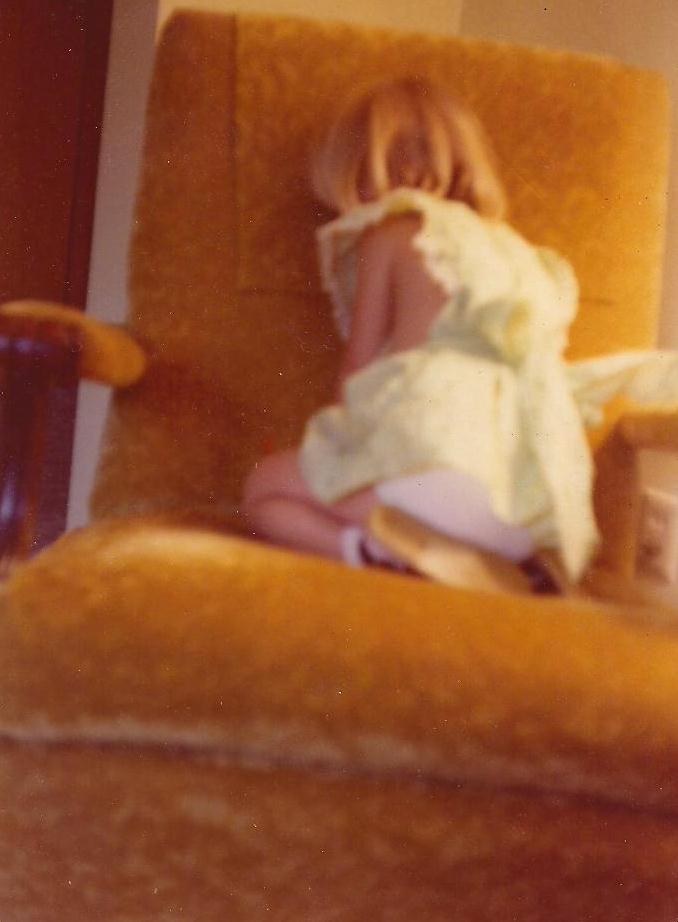
What’s a writer-reader with bohemian taste, an absurd imagination, and lazy tendencies to do in lieu of actual work? Drag an old chair that has been in the family for 40+ years to the middle of her studio and call it a day.

Communing with the chair in the late 1970s.

Before: Communing with the chair in the late 1970s.

The Gold Chair is older than I am. It’s now missing a few buttons and is slightly threadbare in spots; it reminds me of a passage in The Velveteen Rabbit (or How Toys Become Real) by Margery Williams: Continue reading

A Year in Books/Day 220: The Secret (No, Not That One)

  • Title: The Secret The Strange Marriage of Annabella Milbanke and Lord Byron
  • Author: Ashley Hay
  • Year Published: 2000/This Edition: 2001 (Aurum Press Ltd)
  • Year Purchased: 2002/2003
  • Source: Barnes & Noble clearance rack
  • About: This is way more interesting than the “self-help” book by Rhonda Byrne. It’s also real. We all know that Lord Byron (and his buddies) had some hellacious and salacious adventures. Carousing, hell-catting, what-have-you. They were a lot of things, but boring wasn’t one of them. With all of that knowledge in the back of our heads, you’d think that any biography focusing on his personal life couldn’t offer up an intriguing perspective. You’d be wrong, and thank goodness for that. History has certainly seen its share of romantic mismatches and marital disasters. The union between Lord Byron and Annabella Milbanke deserves a fairly high position on any informal ranking. Lest you worry that The Secret is trashy tabloid-esque fodder with a historical spin, fear not! Hay has written a fine exploration, taken from the couple’s journals and correspondence, that gives her subjects a respectful, though not heavy, seriousness.
  • Motivation: We always hear of Byron and his conquests, yet few words are devoted to the women he loved; and most of those are given over to his sister, not his wife. An entire book dedicated to the odd, brief relationship he had with the out-flanked Miss Milbanke? Oh, yes please.
  • Times Read: 1
  • Random Excerpt/Page 38: “At the same time, she became convinced that Byron was about to announce his engagement to someone else-to the young lady, in fact, whom he had told he wanted to see no more of Annabella’s poems. All the light, all the spark, went out of her and out of her effervescent summer: she told her aunt of this imminent announcement so definitely that Lady Melbourne took the idea to Byron as a fact, not a rumour, and he was at a loss to explain its origins or its vehemence.”
  • Happiness Scale: 8 1/2
    Portrait of Annabella Byron (nee Anne Isabella...

    Portrait of Annabella Byron (nee Anne Isabella Milbanke) (1792-1860) (Photo credit: Wikipedia)


A Year in Books/Day 219: American Moderns

  • Title: American Moderns Bohemian New York and the Creation of a New Century
  • Author: Christine Stansell
  • Year Published: 2000 (Metropolitan Books)
  • Year Purchased: 2000
  • Source: History Book Club
  • About: American Moderns is one of my favourite non-fiction books. It was published on the edge of our own new century, and chronicles the birth and growing pains of the one then ending. The narrative focuses on the considerable contributions of the various bohemian elements that came to brilliant prominence in the promising light of this new era. Feminism, labor activism, and radical intellectualism, all action-oriented, fused together to form a progressive platform that, for the first time in America, allowed for a broad, increasingly inclusive, though still problematic, alternative to traditional and oppressive modes of being. These movements were peopled with characters worthy of grand, gritty fiction, including: Louise Bryant, Emma Goldman, John Reed, Hutchins Hapgood, Neith Boyce, Margaret Sanger, Randolph Bourne, Margaret Anderson, Max Eastman, Crystal Eastman, and Susan Glaspell. The resilience of the women is particularly striking. Stansell’s clear voice and excellent scholarship couldn’t be put to better use than they are here, in the complicated telling of this compelling, fractious, and momentous period of history.
  • Motivation: I was thirteen or fourteen when I became interested in the history of activism and feminism. The only things that have changed since then are my knowledge and level of personal involvement in these areas. I also love the literature and pop culture of the earliest years of the twentieth century.
  • Times Read: 3 or 4
  • Random Excerpt/Page 28: “As women lingered at the edges of these urbane circles, they added a sense of themselves as heroines in a new story to bohemia’s increasing store of plots. Just as bohemian identity was intimately intertwined with its representation in print, so was being a New Woman: what one read shaped how one lived.”
  • Happiness Scale: 10+++
    Crystal Eastman was a noted anti-militarist, w...

    Crystal Eastman was a noted anti-militarist, who helped found the Women’s International League for Peace and Freedom. (Photo credit: Wikipedia)