Happy Birthday, Gloria!
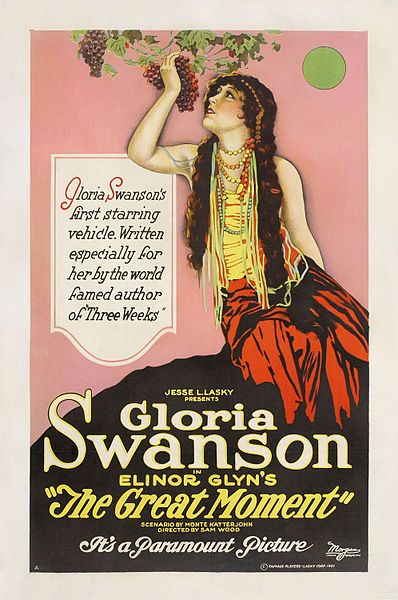
The Great Moment, 1921
“As Daddy said, life is 95 percent anticipation.”

Happy Birthday, Gloria!
The Great Moment, 1921
“As Daddy said, life is 95 percent anticipation.”
Mabel Normand died on 23 February 1930.

Mabel Normand. I played around with a photo from 1915.
I am covering the year 1918. Check back tomorrow for my contribution.

Mary Pickford Invites You to the Classic Movie History Project Blogathon
“All the world’s a stage/And all the men and women merely players/They have their exits and their entrances/And one man in his time plays many parts/His acts being seven ages.”-William Shakespeare

Peter O’Toole
Farewell, dear sir!
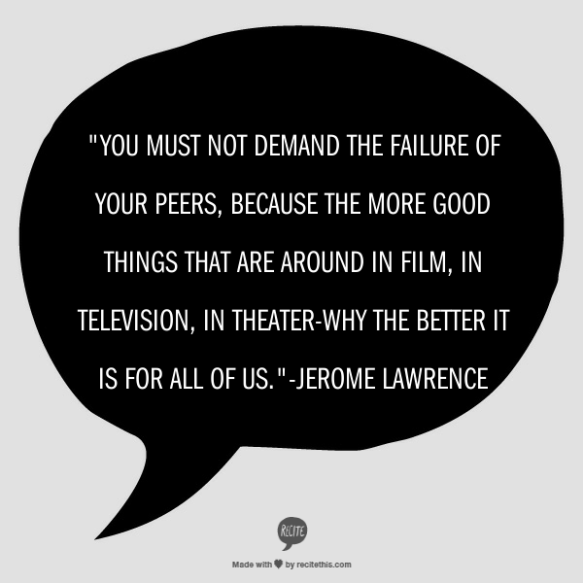
Jerome Lawrence Quote
Ain’t no party like a Gatsby party T-shirt [courtesy Skreened]

Ain’t no party like a Gatsby party T-shirt. $24.99. Image courtesy Skreened.
This is my contribution to The Mary Astor Blogathon. Since I write about classic films in real life, I am thrilled to be able to share a review with my dear ASPL readers. Thanks to Ruth of Silver Screenings and Dorian of Tales of the Easily Distracted for creating and hosting this delightful event.
Don’t let the melodramatic plot fool you. At its heart, and despite its classification, Red Dust (1932) is a sexy, scandalous, brilliant comedy. The dialogue is superb, fast-paced, irreverent, and witty. It’s punchy, and it flows with that rat-a-tat-tat quality so indicative of 1930s American cinema and our collective national psyche as aggressive, plucky go-getters. In many ways, it is a drawing-room comedy without the drawing-room, one transferred to an unlikely setting with its essence preserved: the comedy of manners element is very much in play as characters of different backgrounds, classes, and mores run verbal roughshod over each another. The slight plot of the film, resting comfortably on a triangle, and nicely augmented by the twin pillars of the Madonna-Whore argument and the fish-out-of-water gambit, gets the job done without going out of its way to be innovative. The real thrill is in the writing, the chemistry and playing of the cast, and the speed and leanness of the production. Nothing in the running time of 83 minutes is wasted, including your attention.
*
A rubber plantation during monsoon season is a dreadful place. When it is not raining, the red earth spreads viciously like a plague of locusts. There are beasts, tigers, quite literally outside the gates, where they roar from the shadows into the long hours of the night. Hungry eyes pierce the darkness. Watching. Socialization is limited, the work is hard, the crops are unpredictable, and women are scarce. Pleasures are few, and are taken as they come: without questions or expectations. Prayers are useless, and so is remorse. Continue reading
Ten of the many reasons I am glad there is a major disconnect between film and reality.
10 Movies That Make Writing Look Incredibly Dangerous [courtesy of Flavorwire]

English: Louis B Mayer at the “Torch Song” movie premiere in Los Angeles, Calif., 1953 (Photo credit: Wikipedia)
 A Small Press Life: Books. Art. Writing. Life. Tea.