This gallery contains 8 photos.
This gallery contains 8 photos.

Miles Davis Quote Poster

Henry Miller Quote Poster
Today my muses are spread so far across the map that there really is no map. Yay for eclectic inspiration. Enjoy!
I cannot get enough of John Grant’s new song, Pale Green Ghosts. It is the soundtrack for my packed writing weekend.


I made this “poster” from an excerpt of one of my essays. It was fun! If you want to make a quote poster of your own, go to Recite This. A big thank you goes to Gala Darling for introducing me to this site.
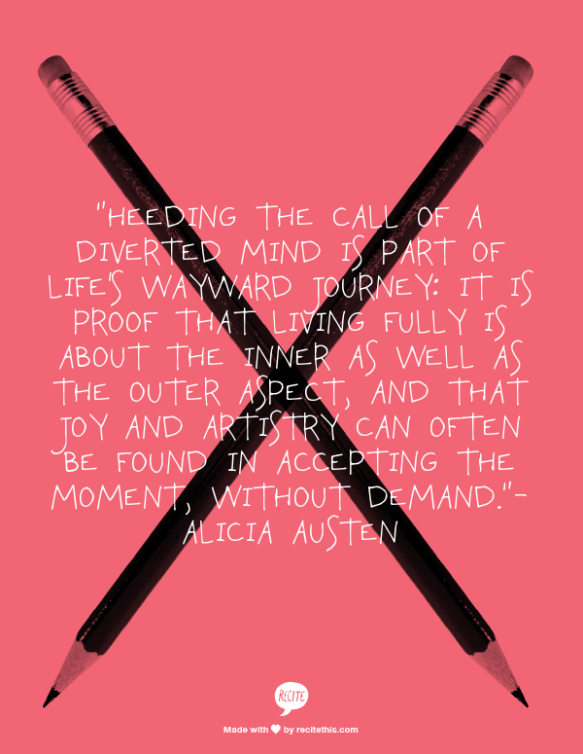
A quote from one of my essays.
What follows is a mad cyclone of some of the oddly delectable bits and bobs setting my head and heart on fire this early November, vintage-style.


Figuring out my audience while writing a young reader’s book.
#4
You know, I would’ve thought that the spirit-crushing doubt that one experiences while stitching up their monster of a writing project was the worst part of the creative ordeal. Turns out I was wrong. The trepidation that kicks in after you finish the first draft can be just as daunting.
Ever hurt yourself in one of those “Ssssssssssssst-OOH!!” kind of ways? Like, you’re shaving a part of your body that you can’t see all that well with a cheap “safety” razor, and then you zig when you should have maintained a nice, smooth, even zag? You hear that “KRTCH!!” of flesh being ripped open, that uncomfortably familiar feeling of something viscous and sticky running from some intimately internal place, and the reality-boggling pain of having shredded the skin off of an inconceivably tender area? If you haven’t, stop reading and go do it, and then you’ll know what I mean.
Arright, so now, you’re in this amazing amount of pain, and you know you’re bleeding. But do you look at it right away? Logically, you would – but there are many of those in this world [me] who would pause before taking a look at his handiwork. There’s something about not looking at the thing that somehow puts off the magnitude of what happened. If I don’t see it, it’s not as bad as it feels. Out of sight, somewhat out of mind.
Right now, I’ve put my story out of sight. I finished the first draft of The Princess Project one week ago (28 October), and I haven’t really looked back since. There’s something mildly unpleasant about reviewing the work I’ve done, as if doing so would show just how truly incompetent I am with the written word. You would think that not glancing back at the finished draft would be a comforting thing, but no – it really only serves to ramp up my sense of dread about what I’ll find when I double-click the file once more.
The theme of this post was going to be doubt, but I find there’s plenty of that to write about here just by thinking about what I wrote. The fear that I will inevitably be razzed for anything I put down is a powerful one, and it works on my whether I’m actually writing or not. I gotta find a way to get over it, to surmount this dread and move forward. It’s really not helping me meet my deadline at all.
KM Scott is an aspiring writer currently teaching English in South Korea. He is currently sweating over a young-reader’s book, the development of which he chronicles in this blog. Pray for him!
Figuring out my audience while writing a young reader’s book.
#3
I’ve always felt that my writing process was akin to the evolution of living species on planet Earth: It is crushingly slow and a lot of things develop that are going to prove unnecessary to the success of the end product, kind of like having a second appendix. One of the things that causes me to drag my feet when getting something down on paper is the “incubation period”, the length of time that I let an idea marinate in my mind before trying to manifest it somehow.
This is where I heavily contemplate detailed elements of the idea, from character quirks to the history of the world the story is set in (the term “thorough daydreaming” would work as a good shorthand, except it’s longer). Normally I’m content to do this to a certain degree, so long as I’m actually producing something. Usually though, the truth is that the incubation period is criminally long in comparison to the production period. It is far easier to think about the story than actually work on it.
However, with this Princess Project that I’m working on, I haven’t allowed myself the luxury of time. I’ve a deadline now, and need to meet it if I’m going to reach my personal goals, not just as a writer, but as a teacher who wants to give his students a gift. That’s not to say that I haven’t gone whole days without writing a darn thing, but nonetheless, the level of dedication I feel that I’m supposed to have is admirable.
Having to work without an extended cooking time is an interesting [frustrating] experience. In truth, I’d come up with the idea several months ago, and so had plenty of time to think casually about the characters, technology, setting, et cetera. This, I found, was the easier part of the story to write. Those parts of the story that I hadn’t already envisioned were pretty easy to make up on the spot. From a technical standpoint, the writing wasn’t a problem.
The voice of the story, on the other hand, was another matter (I’m writing in the past tense here because I’ve finally gotten the first draft done HALLELUJAH). What I mean here is, what techniques should I use to tell the story? Should I use narrative tricks, employ ambiguity to inspire the imagination, be explicit in the detail of the narrative? What kind of language should I use? I mean, my main characters are royal princesses. Keeping my inscrutable audience of young readers (8-14, I guess) in mind, should I write down to what I would have to assume is their level, or should the ladies speak with a learned, scholarly, regal vocabulary?
And how do they speak to each other? The protagonists can be described as Z, the Leader, Ayomi, the Adventurous One, and Ballista, the Smart One Who Shoots Things. There are several different creative avenues to explore here. Should Z be pedantic and virtuous, as Leader heroines are often depicted as, or should she be sly and forward thinking? How exactly do I present Ballista as both a reserved bookworm and wisecracking action heroine at the same time? Does she actually crack wise, or does she make simple, somewhat philosophical statements that turn out to be witty one-liners when one sits and thinks about them?
There are two challenges here. First, I have to get the voices of the characters straight. I know who they are (roughly), I just need to develop how they sound. Second, I have to bring those voices together in harmony; establish how they contrast with each other, bounce ideas between each other, and finish each other’s sentences. In short, they need to become an old married couple (in an all-female, polygamous relationship way).
I find myself missing the incubation period. This would have been spent composing the music of the characters interaction. Sure, it would have taken a ridiculous amount of time, but I would’ve felt more comfortable going into the project. And yet, maybe comfort is not what I need here. Maybe I need to be a bit on edge here, unfettered by any sense of security, in order to challenge my limits and get my best work. This could be a perfect opportunity to train my brain to produce more over a far shorter period of time, which would be an excellent talent to bring into writing for television. Indeed, come to think of it, comfort only delays my desire to create.
I sure liked having it, though.
Next time: DOUBT.
Figuring out my audience while writing a young reader’s book.
#2
In my previous blog post, I outlined a writing project which initially started as out as a children’s book, then became a short story for young readers. As I’d already started the book out with simple, child-friendly language, I found that my workload had doubled up: not only did I have to finish the story, but I had to re-write what I’d already written it for my new audience as well. This endeavor was made all the more complex by the fact that the notion of who exactly my audience consists of is a bit fuzzy to me.
As for the current state of progress on the project, well … allow me to let my inner monologue hold forth on that a bit:
AAAAHHH IT STINKS IT STINKS IT STINKS IT STINKS IT STINKS AAAAHHH!!!
Yeah, that just about sums it up – but not accurately, and not fairly either. There was a certain confidence and ease with which I had written the initial story, two rare aspects of my writer’s mind that were very blatantly absent as I sat in the McDonald’s that night, gently coaxing my simple tale into a complex monstrosity. How could rewriting something be so difficult?!
Upon reflection, the reason why is obvious: The story (let’s call it Fighting Princess Story for desperate lack of a better title) was indeed simple; I’d written it not merely for children, but children for whom English was a foreign language. What’s more was that the students I had in mind were my students, so the text, tone, concepts, and plot of the adventure were strongly informed by the familiarity I had with my small audience.
So now I’m trying to write for an unfamiliar audience, and as one of the posters on my debut article mentioned, writing for “young readers” is difficult in that such a group can mean a large number of people at different levels of maturity, even within specific age groups (8-10, 10-12, and so on).
This has resulted in a bit of a creative paradox. On the one hand, as the upper-limit of maturity of the reader is vaguely defined, I feel a bit freer in what I can do, including lengthening the story, adding some complexity to the plot (not too much, of course), and expanding on the opening badminton game (two of the protagonists like badminton). On the other hand, the lower limit of the potential reader’s skills is almost just as ambiguous, and as such leaves me to wonder just how advanced should the vocabulary be, how much detail is too much detail, or if the dialogue/narrative ratio equals out. Or should it?
Now, honestly, having to deal with such questions would be no massive problem if I were to simply think them through before writing. I’m on a bit of a schedule, however, and so have to deal with these issues as I write the thing. And it was then that I discovered one of the reasons why I am so reluctant to fire up the word processor (or screenplay software) and just spit out one opus after another: self-editing. Not the act of going through a finished piece and looking for typos or places where improvements could be made, oh no – this type of self-editing happens just as you’re beating against the keys.
A line of snappy dialogue pops into your head, and you can’t get it down fast enough. However, what emerges onscreen isn’t the Wilde–worthy bon mot you heard in your mind. So, you stop – you stop the whole #*@$ train! – just to rewrite that line. And … okay, so, this time, it’s a little closer to what you wanted, has a little bit of that spice – but then the issue of whether or not your audience will get it starts nagging at you before you’ve even looked it over good. Will they understand the irony? Is “predicament” a word too high over their heads? Will they comprehend what the character said to begin with? Was the line actually witty, or is the reality that you, the writer, cannot communicate wit, irony, or even a coherent sentence in English even if possessed by the spirit of a dead grammar book?
This, I realized, is literally quite tiring. A wealth of creative energy is being used on these pathetic little hiccups that could probably be resolved far more casually in a second or third draft. It’s hard to see that when in the thick of it, of course, at which point the idea of doing a second draft seems ludicrously cruel since you haven’t finished the first.
But nitpicking and over-agonizing ain’t the half of it, oh no. See, when you start dealing with one tiny conundrum after another, those conundrums seem to pile up. Soon, the belief begins to creep in that what you’ve written is not a story so much as it a gigantic collection of inadvisable, self-important screw-ups which serves better as an example of how to fail as a writer than a piece of literary entertainment. This kind of thinking eats into your self-esteem. You feel bad because this thing that you made in your mind is not behaving the way it should. What kind of writer are you if you can’t control your writing? Maybe you should have done what your mother insisted and become a neurosurgeon. Pft. Shyeah, right. You would’ve blown that too.
Then after slinking off your laptop and letting things sit for a while, your level-headedness kicks in (though not enough to tell you to stop being a writer) and reminds you that you haven’t cleared the middle of the story yet. It’s too early to start cutting yourself down. There’s plenty of time for that after the story is finished. But no, seriously – the thing is not that bad.
I get so bogged down in silly little details and self-consciousness that I forget (neglect) to get the thing done. I have to remember that sometimes the best thing to do is just smash through to the end of the story, let it go for a while, and then go back and revise. Trying to be peerlessly brilliant on the first attempt is simply putting myself in a pressure cooker for no good reason. I need to learn to relax and, if humanly possible, enjoy the writing experience.
To this end, I have made it a point not to worry so much about what I should or shouldn’t write – I’ll just write it. The fixes will be simple and readily available after the first draft is completed; there’s no reason to worry about a poor result so early in the development stage. You must first learn to walk before you can run headlong into a telephone pole.
Next time, character development on the fly.
Figuring out my audience while writing a young reader’s book.
It was earlier in the year when I had the inspiration. My work as a kindergarten teacher in a hagwon gave me the idea for a book series featuring heroic princesses in action-packed adventures written for kids. Excited about the idea, I shared it with my students (all between the ages of 7 and 8), and banged out an excerpt of the story with drawings to give to them as birthday gifts.
At some point – I cannot recall when – it occurred to me to make the thing bigger. To go from a six page excerpt to a completed work wasn’t good enough. Now, the dream had expanded: I wanted to bring the plights of my heroines into the world of young readers. The method? Self-publishing. The resources? My laptop, Lulu.com, and an artist commissioned to do the illustrations. All that left was the story!
Hm. The story. Well, the story pretty much wrote itself – good guys (gals) vs. bad guys (a woman with a machine gun, air superiority, and an extremely anti-social attitude). The problem was that, for some reason, I decided to write for a new audience. So now, my quest is to write my story for a nebulous, hard-to-define, kinda cloudy group of readers somewhere between the ages of 8 and 13.
It’s not an easy task. I’ve always found it easier to figure out my taxes than to figure out my audience. When my focus was narrowed to kindy kids who were learning English, things were relatively simpler: if I wanted to use a word longer than three syllables, I instead put in a substitution a smaller word or phrase that meant the same thing. I even intended to put a glossary* in the back for certain words, with the intent of hopefully helping ESL students expand their vocabulary.
Writing for this older group of readers is a different story as itt’s a group that I’m unfamiliar with. I was 8-to-13 years old myself once, but it was only for a couple years back in the early 80s. At 38, I feel that I’ve moved on since, and as such I don’t quite remember how challenging reading was. Heck, I was a good reader; it was never really a challenge for me – just boring. I was a movie fan. So, when it came to all the books you were supposed to read from 8-13, I never bothered. The Lion, the Witch, and the Wardrobe, the Lord of the Rings trilogy, Lizard Music, Old Yeller, Are You There God? It’s Me, Margaret, The Anarchists Cookbook, and so on, never had an impact on me.
That’s what this blog is about. I’m pretty much going to have to figure out how my new audience works. How complex should the vocabulary be? How much detail should I use when establishing background, character, settings? Should I concern myself with whether boys will like reading a book where the protagonists are all young women?
Now, I’m not going to pretend that readers are going to be clamoring for this thing-– it’s really just a personal project I’d like to see done before my students graduate in March, so I can gift it to them as a reward for putting up with me all year. Perhaps it’ll be a little over their ability now, but it could end up being something they could use to sharpen their reading skills later.
So, for anybody out there who’s ever struggled in trying to figure out just how to write for your readers, here’s your chance to watch as I fly face-first into such and adventure. I’ll be glad to have you along for the ride.
* glossary: a list at the back of a book, explaining or defining difficult or unusual words and expressions used in the text
I’m a niche writer. I don’t see eye-to-eye with the mainstream media, and that’s okay: I’m happy to go my own quirky way, even in a professional capacity. I’m fortunate to write about subjects that I truly love: dead writers, literary culture, weird short fiction and, of course, classic movies. I’ve been writing about the latter for a decade but, over those years, my focus has narrowed: I now write mostly on silent cinema. Oh, my beloved!
My home city has many amazing, memorable murals (hello, half-upside-down American Gothic!). My favourite-which I discovered a year ago as my mom was scouting out new apartments in this downtown neighborhood-is in the parking lot of a law school. It was so unexpected that I sucked in my breath before letting out a loud squeal. I may have jumped up and down but this is where the memory becomes foggy. Behold: Continue reading
 A Small Press Life: Books. Art. Writing. Life. Tea.