
[R]evolving Incarnations: A Questionnaire for Passionate Readers-Featuring R.A. Kerr of Silver Screenings

[R]evolving Incarnations: A Questionnaire For Passionate Readers is an interview series done in classic Q&A format. Each entry features one intrepid writer/blogger/artist/creative mastermind as they take on the same 40 reading-themed questions and scenarios. Be sure to leave your thoughts in the comments section!

R.A. KERR

R.A. Kerr is the writer behind the amazing classic movie blog, Silver Screenings.

  • What book have you always wanted to read, but haven’t? Why? The Rise and Fall of the Third Reich by William L. Shirer. Once I start it, I know I’ll do nothing else until I finish. No blogging, no socializing, no tooth-brushing. That’s quite a commitment. 
  • What is your favourite line or passage from a book? “The mystery of wood is not that it burns, but that it floats.”-from “Fugitive Pieces” by Anne Michaels. In a novel full of mystery, this single line reminded me that there is mystery in the ordinary. We only need to look.
  • Who do you think is the most underrated author? Ray Robertson, author of “What Happened Later.” Genius.
  • What is your pick for the most underrated book? “A Woman in Berlin: Eight Weeks in the Conquered City” by Anonymous. This is the true, gut-wrenching account of how one woman survived the Russian occupation of Berlin in the waning days of WWII.
  • If you could make everyone in the world read one book, what would it be? “A Fair Country” by John Raulston Saul. To me, this book best explains the elusive “Canadian Identity.” 
  • Is there a book you wish you had written? “How to Make an American Quilt” by Whitney Otto. There were times I couldn’t breathe for the beauty and cleverness of her writing. Continue reading

[Alternative Muses] Writerly Style: Daphne du Maurier

“Vain trifles as they seem, clothes have, as they say, more important offices than to merely keep us warm. They change our view of the world and the world’s view of us.”-Virginia Woolf, Orlando

It is difficult to avoid peddling clichés when discussing Daphne du Maurier’s personal style: there’s just something so vigorously English about her look.

Daphne du Maurier

Daphne du Maurier

See what I mean? Her fresh-scrubbed bluntness still bewitches. Whatever the truth of her routine, she looks like a woman whose morning ablutions consisted of plunging her face into a cold stream, followed by a haphazard spritz of rose-water, mirror-less application of the perfect red lipstick, and a few deep breaths. Whether she spent the day at her typewriter or traipsing through fragrant fields with clever dogs gamboling at her heels, it’s obvious that she was sartorially prepared.


Daphne du Maurier and family

Daphne du Maurier and family

Check out that tweedy magnificence! Doesn’t it make you want to throw out all fussiness from your wardrobe, peel away the unnecessary layers of routine, to streamline, distill, simplify? That is one powerfully chic, easy, wearable silhouette. A put-it-on-and-forget-about-it-yet-look-better-than-everyone-else type of ensemble.
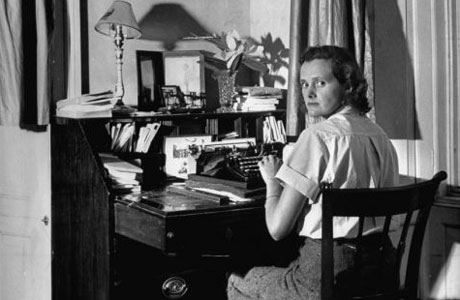
Daphne du Maurier at work

Daphne du Maurier at work

I don’t know many writers who look this crisply put together on the job, myself included. Yet, typewriter or no, she looks like a writer should look, doesn’t she? Serious, simply adorned, polished, comfortable. Ready to work, to create, to sweat it out, to answer an unexpected knock at the door without shame or a mad scramble for something suitable to wear. Every image of du Maurier seems to scream, “That, that was a woman who knew how to live.”

DAPHNE DU MAURIER (1907-1989)

SOME WORKS:

  • The Loving Spirit (1931)
  • Jamaica Inn (1936)
  • Rebecca (1938)
  • Frenchman’s Creek (1941)
  • Hungry Hill (1943)
  • My Cousin Rachel (1951)
  • Mary Anne (1954)
  • The Birds and Other Stories (1963)
  • Not After Midnight (1971)

“Writers should be read, but neither seen nor heard.”Daphne du Maurier

The Dead Writers Round-Up: May 1st-6th

  • Joseph Addison was born on 5/1/1672. “A man should always consider how much he has more than he wants.” (Cato; numerous essays)
  • John Dryden died on 5/1/1700. “He has not learned the first lesson of life who does not every day surmount a fear.” (Astraea Redux; Secret Love, or The Maiden Queen; All for Love; Amphitryon; King Arthur)
  • Marie Corelli was born on 5/1/1855. “If we choose to be no more than clods of clay, then we shall be used as clods of clay for braver feet to tread on.” (A Romance of Two Worlds; Wormword: A Drama of Paris; The Sorrows of Satan)
  • Joseph Heller was born on 5/1/1923. “Rise above principle and do what’s right.” (Catch-22; Something Happened; Closing Time)
  • Harold Nicolson died on 5/1/1968. “We are all inclined to judge ourselves by our ideals; others by their acts.” (Paul Verlaine; Public Faces; Dwight Morrow; King George V)
  • Alfred de Musset died on 5/2/1857. “Great artists have no country.” (Lorenzaccio; Le Chandelier; Bettine; The Confession of a Child of the Century) Continue reading

The Dead Writers Round-Up: April 17th-19th

  • Marie de Sévigné died on 4/17/1696. “The desire to be singular and to astonish by ways out of the common seems to me to be the source of many virtues.” (A voluminous correspondence, via letters to her daughter)
  • Isak Dinesen was born on 4/17/1885. “The cure for anything is salt water: sweat, tears or the sea.” (Seven Gothic Tales; Out of Africa; Anecdotes of Destiny)
  • Thornton Wilder was born on 4/17/1897. “Do any human beings ever realize life while they live it?” (The Long Christmas Dinner; Our Town; The Merchant of Yonkers; The Skin of Our Teeth; The Matchmaker; The Bridge of San Luis Rey; Ides of March; The Eighth Day) Continue reading