Off Topic Post: Happy 100th Birthday, Vivien Leigh!

Vivien Leigh was born Vivian Mary Hartley on 5 November 1913.

Young Viv

Young Viv

She was a very, very fine actress of stage and screen. If you’ve only seen Gone with the Wind or A Streetcar Named Desire, you have missed some wonderful film performances. Her theatrical work has, of course, been lost to time. It’s a shame, because she was a serious and brilliant stage actress obsessively dedicated to her craft. Her film stardom was largely beside the point.-“I’m not a film star, I am an actress. Being a film star is such a false life, lived for fake values and for publicity.”-Vivien Leigh

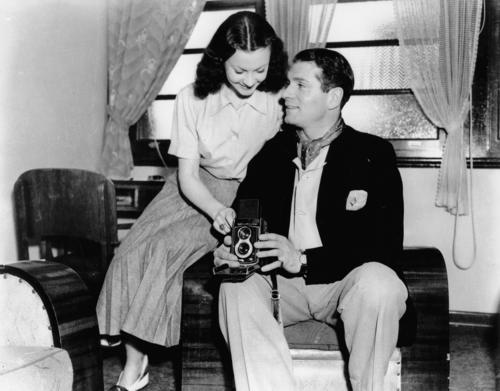
She was married to this chap for two decades.

Vivien Leigh and Laurence Olivier, June 1948

Vivien Leigh and Laurence Olivier, June 1948

She died on 8 July 1967.

Vivien Leigh

Vivien Leigh

If I ever find a time machine, I will make dozens of stops just to see the magnetic and fiercely talented Vivien Leigh weave her magic across the world’s stages.

Happy Birthday to an Icy Looking Elinor Glyn

Elinor Glyn, who forever changed the popular culture landscape by ballyhooing the concept of It, was born on 17 October 1864.

Elinor Glyn

Elinor Glyn

A QUOTE: “Everything that I write will be signed with my name.”

SOME WORKS: Beyond the Rocks; Three Weeks; Three Things; Love’s Blindness; ‘It’ and Other Stories

A KEEPSAKE:

Elinor Glyn's Man and Maid Movie Still Book at Backwoods Treasure

Elinor Glyn’s Man and Maid Movie Still Book at Backwoods Treasure Antiques. $26.95

Daily Diversion #161: Reading with George

George Bellows Bookmark

Bookmark: Stag at Sharkey’s, 1909, by George Bellows Book: STILL, by David S. Shields

“Both of the inventors of the visual glamour, Eickemeyer and Genthe, came from the ranks of the art photographers, that cadre of aesthetically ambitious cameramen and-women who in the 1890s organized into an international community intent on fighting the slapdash amateurism of the mass of Kodak-wielding weekend shutterbugs, the routine posing and eclectic composition of the professional portrait studio, and the condescension of a fine arts critical establishment that denigrated photography as a mechanical craft.”-STILL American Silent Motion Picture Photography, by David S. Shields

Daily Diversion #126: Sometimes I Get to Do Awesome Things!

One of my writing specialties is silent cinema. It’s actually one of the great loves of my life, and so is Buster Keaton. Last night, The Chef and I had the rare treat of seeing Steamboat Bill, Jr. (1928) on the big screen. The show was held in the ballroom of the stunning Cincinnati Music Hall. Clark Wilson provided musical accompaniment on the Hall’s restored “The  Mighty Wurlitzer”. This is my favourite Keaton production. I have watched it at least 20 times, but always in the privacy of my home. The joy of experiencing a silent movie whilst surrounded by hundreds of spontaneously laughing people seeing it for the first time is energetic and awe-inspiring. Buster, who made his film debut 96 years ago, would certainly be proud and humbled. It was a wonderful evening to be a cinema buff and writer.

This slideshow requires JavaScript.

“The first thing I did in the studio was to want to tear that camera to pieces. I had to know how that film got into the cutting room, what you did to it in there, how you projected it, how you finally got the picture together, how you made things match. The technical part of pictures is what interested me. Material was the last thing in the world I thought about. You only had to turn me loose on the set and I’d have material in two minutes, because I’d been doing it all my life.”-Buster Keaton

[The Mary Astor Blogathon] Red Dust: Who Knew That Rubber Plantations Were So, So Sexy?

This is my contribution to The Mary Astor Blogathon. Since I write about classic films in real life, I am thrilled to be able to share a review with my dear ASPL readers. Thanks to Ruth of Silver Screenings and Dorian of Tales of the Easily Distracted for creating and hosting this delightful event.

Don’t let the melodramatic plot fool you. At its heart, and despite its classification, Red Dust (1932) is a sexy, scandalous, brilliant comedy. The dialogue is superb, fast-paced, irreverent, and witty. It’s punchy, and it flows with that rat-a-tat-tat quality so indicative of 1930s American cinema and our collective national psyche as aggressive, plucky go-getters. In many ways, it is a drawing-room comedy without the drawing-room, one   transferred to an unlikely setting with its essence preserved: the comedy of manners element is very much in play as characters of different backgrounds, classes, and mores run verbal roughshod over each another. The slight plot of the film, resting comfortably on a triangle, and nicely augmented by the twin pillars of the Madonna-Whore argument and the fish-out-of-water gambit, gets the job done without going out of its way to be innovative. The real thrill is in the writing, the chemistry and playing of the cast, and the speed and leanness of the production. Nothing in the running time of 83 minutes is wasted, including your attention.

*

 A rubber plantation during monsoon season is a dreadful place. When it is not raining, the red earth spreads viciously like a plague of locusts. There are beasts, tigers, quite literally outside the gates, where they roar from the shadows into the long hours of the night. Hungry eyes pierce the darkness. Watching. Socialization is limited, the work is hard, the crops are unpredictable, and women are scarce. Pleasures are few, and are taken as they come: without questions or expectations. Prayers are useless, and so is remorse. Continue reading