Ain’t no party like a Gatsby party T-shirt [courtesy Skreened]
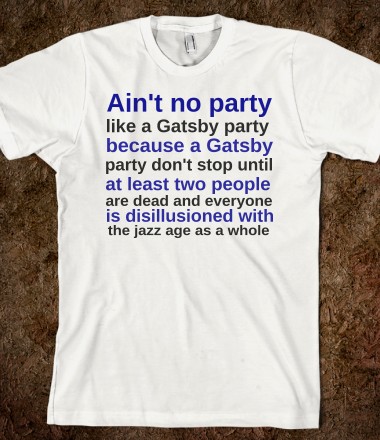
Ain’t no party like a Gatsby party T-shirt. $24.99. Image courtesy Skreened.

Ain’t no party like a Gatsby party T-shirt [courtesy Skreened]
Ain’t no party like a Gatsby party T-shirt. $24.99. Image courtesy Skreened.

My serious writer face.
“Of all that is written, I love only what a person has written with his own blood.”-Friedrich Nietzsche

Joseph Heller Quote
We’ve racked up quite the decent amount of followers in the sixteen months that A Small Press Life has been on WordPress. Yesterday, I noticed that a milestone of awesome and humbling proportions was passed. I want to take a few seconds to thank all of our readers, who help make this place whatever this place is (of which you are the judges, not us, so we’ll leave it at that). Kevin and I are indebted to all of you for making A Small Press Life‘s comments section a home for intelligent, witty, and lively literary discourse. While we’d take quality over quantity any day, you’ve given us both. Dead Writers still rock, and so do you!
Since I cannot bake cupcakes for the lot of you, here’s a pic instead:

A webcam recreation of my surprised, we-have-how-many-followers? face.
The thought of deconstructing my studio space book-by-book, inspiration-by-inspiration, packing them away, carting their heavy bodies off to some as-yet-unknown location, and painstakingly re-assembling the lot is an awful concept to ponder for even two seconds. While the physical contents of my creative life will be carried to this new place, the sense of energy and safety that I’ve enjoyed here, in this spot, for 3 years, are nontransferable. They cannot be put back together again, but must develop organically in a new form that might not be instantly or easily recognizable.
I require a lot from my creative surroundings. Aside from practical considerations of size and wall space and aesthetics, most of my needs are psychological: a logical necessity that somehow manages to defy many points of logic. It doesn’t matter, though. I need what I need in order to write, to create, to be. To be, what? Effective, fertile, happy, productive. I’m drawn to this subject every time a move is on the horizon, when my well-being is jeopardized, scattered, marginalized. That time is almost here. I thought it would be nice to share part of this with you, as it illuminates another of the many over-looked facets of being a writer (or reader). So much of the creative process is odd, hidden, never discussed. Maybe we think that people, including other writers, only want to hear about the practicalities of writing and editing and marketing; about characterization and plots and publishing. I think most of us know that the truth is stranger and more fruitful than that: this truth, so universal, is also boring, terrifying, lyrical, sad, and hopeful. So, let’s do this. Let us look at writing and creating from unexpected angles. Showing the dust in the corners of the literary world is, after all, what this blog is all about.
How important is sense of space to your creative process?
Anne Brontë’s Updated Gravestone [courtesy BBC]

Nancy Carroll agrees that it’s wonderful to be back, darlings!
“Vain trifles as they seem, clothes have, as they say, more important offices than to merely keep us warm. They change our view of the world and the world’s view of us.”-Virginia Woolf, Orlando
It is difficult to avoid peddling clichés when discussing Daphne du Maurier’s personal style: there’s just something so vigorously English about her look.

Daphne du Maurier
See what I mean? Her fresh-scrubbed bluntness still bewitches. Whatever the truth of her routine, she looks like a woman whose morning ablutions consisted of plunging her face into a cold stream, followed by a haphazard spritz of rose-water, mirror-less application of the perfect red lipstick, and a few deep breaths. Whether she spent the day at her typewriter or traipsing through fragrant fields with clever dogs gamboling at her heels, it’s obvious that she was sartorially prepared.

Daphne du Maurier and family
Check out that tweedy magnificence! Doesn’t it make you want to throw out all fussiness from your wardrobe, peel away the unnecessary layers of routine, to streamline, distill, simplify? That is one powerfully chic, easy, wearable silhouette. A put-it-on-and-forget-about-it-yet-look-better-than-everyone-else type of ensemble.
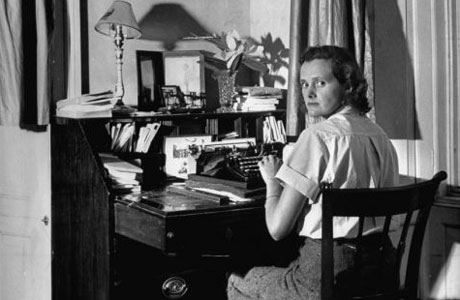
Daphne du Maurier at work
I don’t know many writers who look this crisply put together on the job, myself included. Yet, typewriter or no, she looks like a writer should look, doesn’t she? Serious, simply adorned, polished, comfortable. Ready to work, to create, to sweat it out, to answer an unexpected knock at the door without shame or a mad scramble for something suitable to wear. Every image of du Maurier seems to scream, “That, that was a woman who knew how to live.”
DAPHNE DU MAURIER (1907-1989)
SOME WORKS:
“Writers should be read, but neither seen nor heard.”–Daphne du Maurier
…is a fascinating and priceless literary and cultural treasure. Filling the years 1919-1938, it is a neat autobiography of his (and Zelda’s) professional output and earnings. The whole thing is now available on-line. Go there, go there now! It is a first-class time-waster worth every second.
F. Scott Fitzgerald’s Ledger [courtesy University of South Carolina]
His handwriting is elegantly divine.
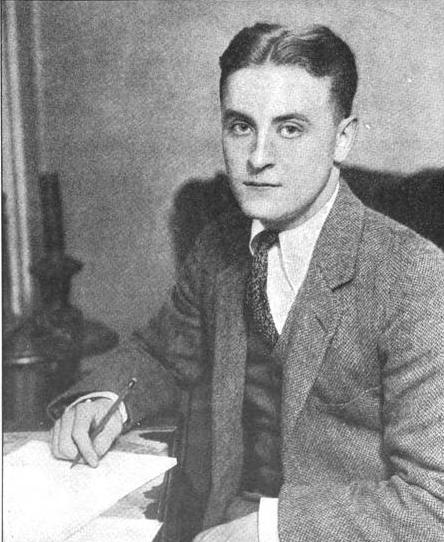
F. Scott Fitzgerald, meticulous record-keeper, in 1921.
 A Small Press Life: Books. Art. Writing. Life. Tea.