Unknown's avatar

About maedez

Writer, biographer, poet. History nerd, silent movie maven. Punk rocker, amateur baker, bookworm. Cricket fan, Scotch drinker, craft beer snob.

Daily Diversion #9: Emily Dickinson

I'm nobody, who are you?

I’m nobody, who are you?

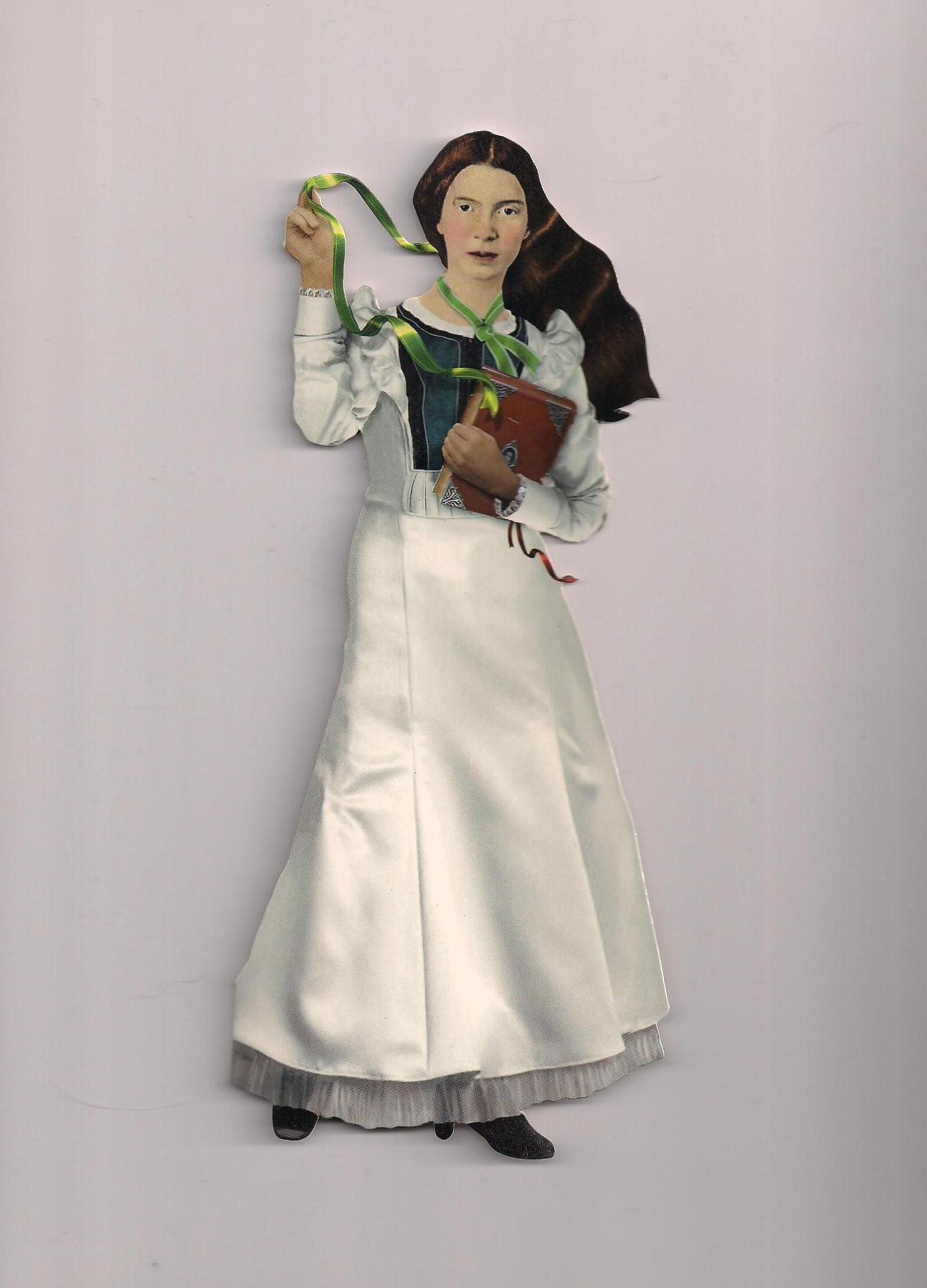
This literary paper doll was a birthday gift from my mom about 5 years ago. She lives on a shelf in my studio, staring at me from behind a glazed ceramic urn full of Tardis dessert flags.

Beauty is not caused. It is.

Beauty is not caused. It is.

Her deceptively simple poetry quickens the mind, the heart, the blood, the creativity that dwells within us all, hidden yet frantic to escape.


A Year in Books/Day 138: Fanny Stevenson

  • Title: Fanny Stevenson Muse, Adventuress & Romantic Enigma
  • Author: Alexandra Lapierre
  • Translator: Carol Cosman
  • Year Published: 1995/This Edition: 1996 (Fourth Estate)
  • Source: Barnes & Noble clearance rack
  • About: This book was my introduction to Fanny Stevenson, the wife and widow of Robert Louis Stevenson. Lapierre’s wonderful, detailed and complex biography neatly answers two questions: Why did the great Scots writer fall in love with, and sacrifice so much for, this unknown, controversial American woman? Who, exactly, was Fanny Vandegrift Osbourne? In order to explicate on the great mystery that is the former, Lapierre goes to impressive lengths of research to figure out the latter. In answering these questions, it is obvious that the subject and her extraordinary life would have been worth the resultant biography even had she never met and married the writer of the Strange Case of Dr. Jekyll and Mr. Hyde, Treasure Island and Kidnapped. As a plucky, resourceful, intelligent, resilient and talented woman, she emerges as much more than just a ‘great man’s’ muse.

    Fanny Osbourne, shortly before her meeting wit...

    Fanny Osbourne, shortly before her meeting with Robert Louis Stevenson. Français : Fanny Osbourne, peu de temps avant sa rencontre avec Robert Louis Stevenson. (Photo credit: Wikipedia)

  • Motivation: I love obscure artistic ladies, especially when they are armed with an excessive amount of fighting spirit and intelligence.
  • Times Read: 1
  • Random Excerpt/Page 272: “Fifteen years later, on the eve of his own death, Robert Louis Stevenson described his wife to one of his friends: Hellish energy relieved by fortnights of entire hibernation…Doctors everybody, will doctor you, cannot be doctored herself.
  • Happiness Scale: 10

A Year in Books/Day 137: Lion in the White House

  • Title: Lion in the White House A Life of Theodore Roosevelt
  • Author: Aida D. Donald
  • Year Published: 2007 (Basic Books)
  • Year Purchased: 2008/2009
  • Source: History Book Club
  • About: This short biography of the 26th President of the United States of America manages, in spite of its abbreviated length, to chip away at the bull in the china shop cliché that has followed T. Roosevelt down the decades. Ably written and engaging, it’s a remarkably satisfying read in a small package.
  • Motivation: It was sent to me by mistake. I paid for it and kept it, anyway. Probably from sheer laziness.
  • Times Read: 1
  • Random Excerpt/Page 64: “The more prosaic Roosevelt plunged right in to his new social environment, entertaining as though he were still in a smaller world. In Washington, social life depended on officeholders who had money beyond their salaries and who could, therefore, entertain lavishly in sumptuous houses. These leading lights mixed business with pleasure all the time, something Roosevelt found new but bracing. That the Roosevelts lived in modest circumstances was irrelevant; he fit into the Washington social scene because he came from an elite background and held an important position.”
  • Happiness Scale: 8
    Theodore Roosevelt (1904) English: President o...

    Theodore Roosevelt (1904) English: President of the United States Theodore Roosevelt, head-and-shoulders portrait, facing front.(Photo credit: Wikipedia)


Shopping for the Bookworm: New England Transcendentalists Edition

For some reason, I have been thinking a lot about the New England Transcendentalists. Maybe it is the image of Margaret Fuller that stares down at me from one of my inspiration boards. Whatever the cause, it is a fine subject to be preoccupied with on a lovely Spring day. In honor of today’s one-track thought process, I’ve collected an inspiring and eclectic group of NET-inspired goodies. Enjoy!

This shop is so full of literary-themed profiles that every visit requires a gargantuan exercise in restraint. I want them all, I went them all now! Continue reading

Daily Diversion #8: An Old Man’s Gift (The Ford Times)

I do the blogging for a local gallery chain. We carry a lot of Charley Harper pieces (as in, the most in the world). Nine months ago, this would have meant absolutely nothing to me. Even though I’ve moved (mostly) in and (occasionally) out of the art world for the bulk of my adult life, I had barely heard of him before starting this gig. Back in “the day”-in this case the 1950s onwards-he did a lot of illustrations for a  magazine called the Ford Times, which I had definitely never heard of. Even though I love old periodicals. (I think I can be forgiven for not reading old copies of a lifestyle magazine put out by the Ford Motor Company, right?) Anyway, I will try to wrap this up in a neat, figurative bow because, well, this is a diversion piece. As we know, in my universe, that constitutes a few sentences and a photograph or two. Moving on….
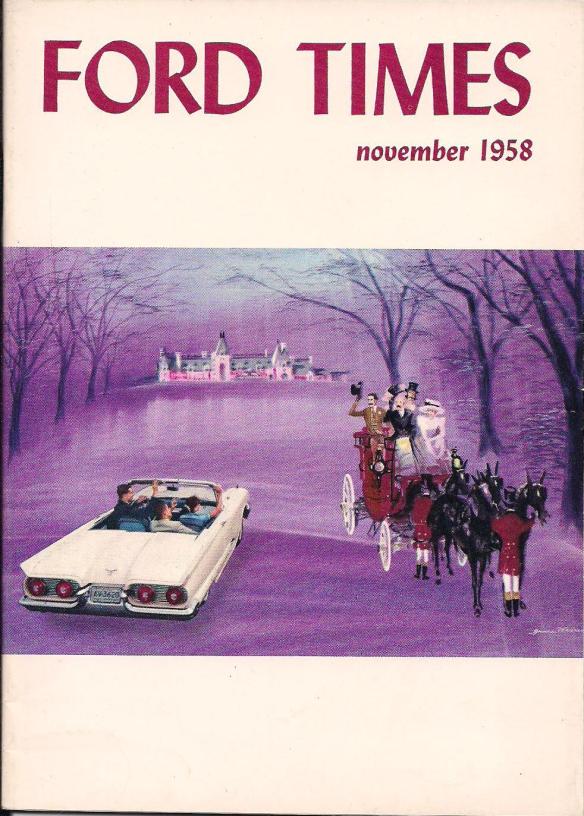
Ford Times, November 1958

Ford Times, November 1958

I met a delightful old man yesterday afternoon. After he found out that I sometimes write about Charley Harper, he gave me this excellently preserved copy of the Ford Times. Although I have seen most of the prints made from these illustrations, I had never seen the magazine before. I had no idea that it was so small! I thought that it was a full-sized periodical.
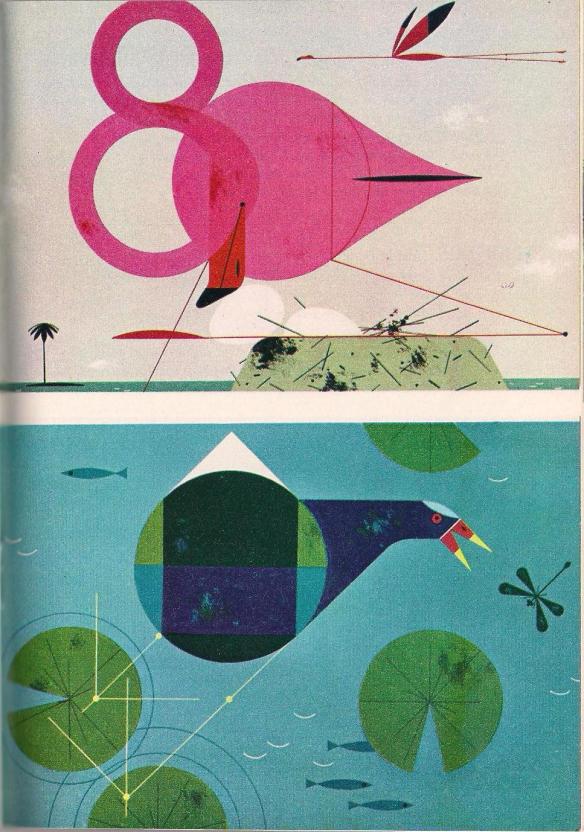
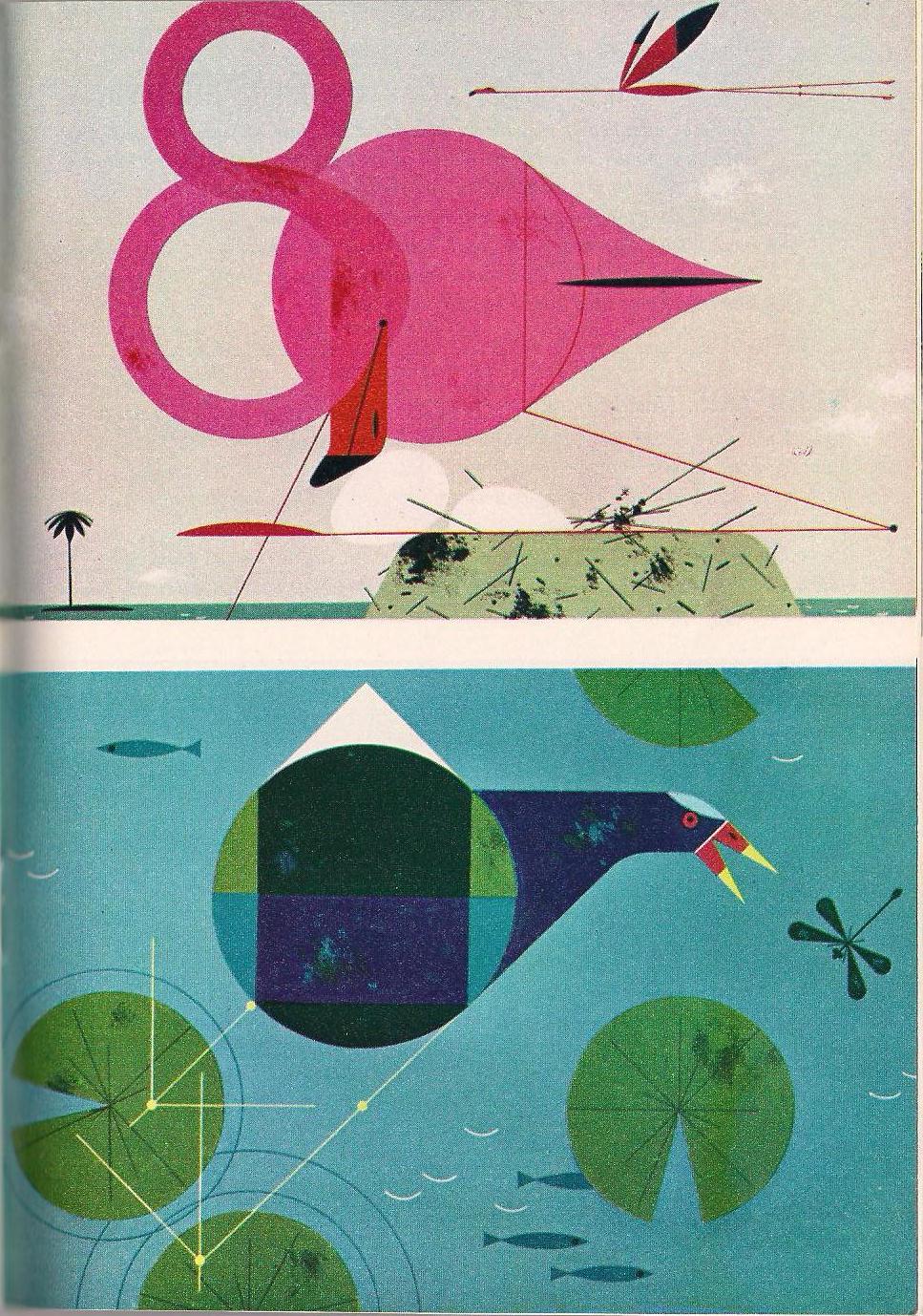
Top: Flamingo by Charley Harper Bottom: Purple Gallinule by Charley Harper

Top: Flamingo by Charley Harper Bottom: Purple Gallinule by Charley Harper

He didn’t just gift me with any Ford Times issue, but one that featured some of the images I have written about. I love the flying flamingo in the background of the top illustration.

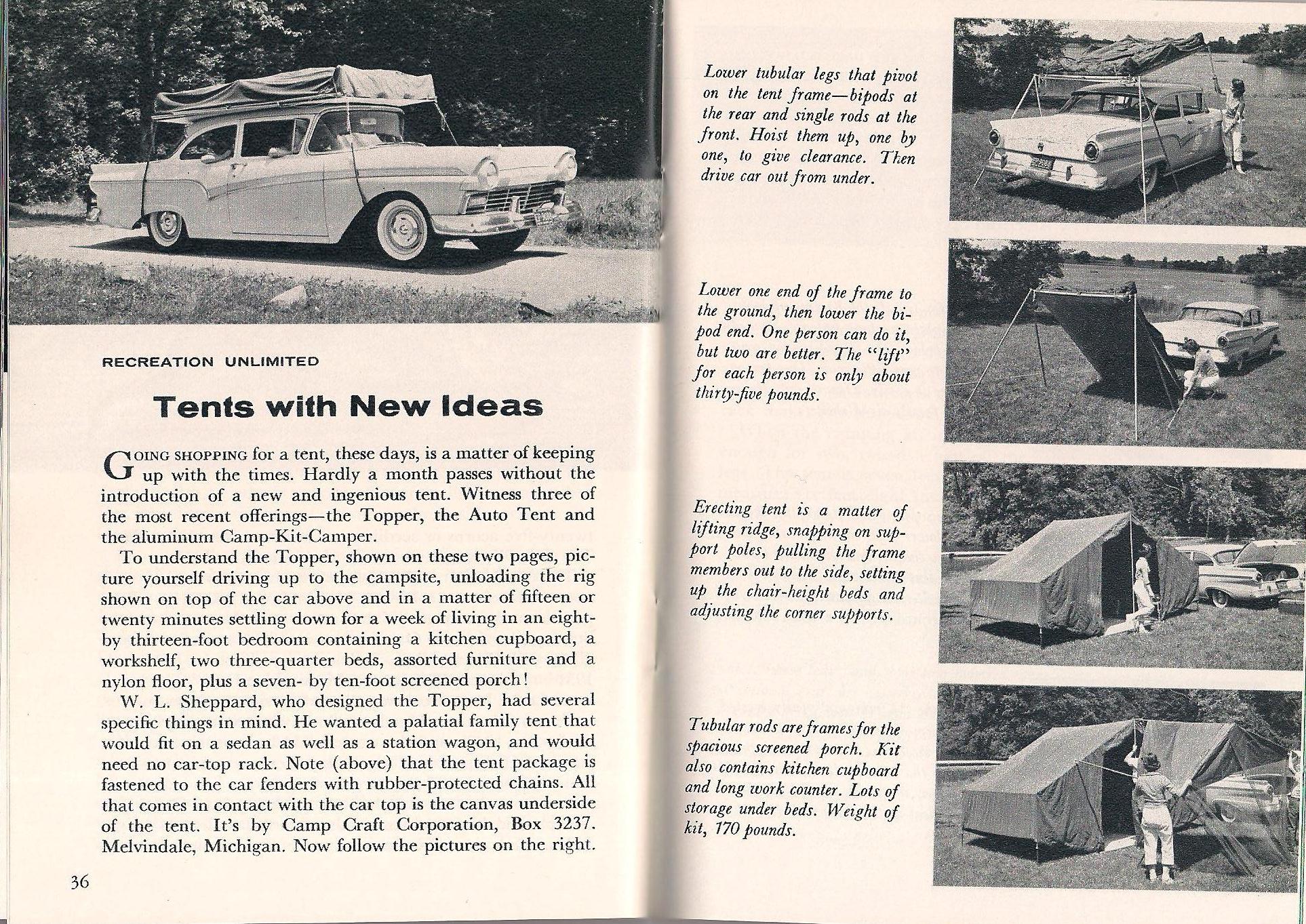
Tents with New Ideas

Tents with New Ideas

This layout makes me want to go camping, badly. But only if I can have that awesome car and the sweet tent, which actually makes setting up camp look fun! This story alone made my day (I’m weird like that). Thank you, Mr. Old Man! Your gift is in good hands.

A Year in Books/Day 136: Starstruck

  • Title: Starstruck
  • Author: Jib Fowles
  • Year Published: 1992 (Smithsonian Institution Press)
  • Year Purchased: 1993?
  • Source: Little Professor Book Center
  • About: Jib Folwes would like to welcome you to Star Village, a term he coined to cover the 100 celebrities who, at any given time, receive the highest concentration of interest by the public. Although early 21st century forms-such as the Internet, YouTube, and reality television-have perhaps skewed the numbers and demographics, the foundation of his theory remains strong. He dissects every aspect of stardom, starting with how modern celebrity came to be, how it is achieved, maintained, and how, for some, it dies. He uses a cross-section of actors, musicians, comedians, and athletes, including: Louis Armstrong, Clara Bow, Doris Day, Buster Keaton, Billie Jean King, John Lennon, Liberace, Steve McQueen, Marilyn Monroe, Roy Rogers, Babe Ruth, Lawrence Welk and Mae West. It is a fascinating, almost sociological, look at a hierarchy we are born into, take for granted, and rarely seriously question.
  • Motivation: I’m a sucker for old Hollywood. I also love the logic, research and data behind serious sociological studies, even when the subject is pop culture.
  • Times Read: 2
  • Random Excerpt/Page 75: “Viewed within the context of the twentieth century’s eruption of metropolitan living and machine production, the star phenomenon can be seen to have resulted from two historical imperatives. The need of uprooted city dwellers for personality models was compelling enough, but a second force-related yet distinct-was at work.”
  • Happiness Scale: 9 1/2
    Publicity photo of musician Lawrence Welk.

    Jib Fowles will tell you why, exactly, I became famous! (Photo of Lawrence Welk courtesy of Wikipedia)


[Alternative Muse of the Month] Let’s Talk About Katherine Mansfield’s Miss Brill, or: Why Writers Deserve Silly, Media-Created Nicknames, Too

I dream of a world where people care enough about writers to give them silly, unnecessary and catchy nicknames. Move aside JLo and LiLo, because here comes JAust (pronounced joust, because it just sounds better). Are you sick of Brangelina and, Lord help us, Kimye? Fear not, because SylT is here to make it all better. (For the record: I refuse to acknowledge the talented but dickish Ted with more than a perfunctory T.) I could do this all day (and probably will in some future post, because this is kind of fun, yes?) but I’ll stop after one more, the subject of this piece: KathMans. Continue reading

The Dead Writers Round-Up: 17th-20th May

  • Dorothy Richardson was born on 5/17/1873. “If there was a trick, there must be a trickster.”
  • Nathaniel Hawthorne died on 5/19/1864. “The only sensible ends of literature are, first, the pleasurable toil of writing; second, the gratification of one’s family and friends; and lastly, the solid cash.” Continue reading

A Year in Books/Day 135: Writing Dramatic Nonfiction

  • Title: Writing Dramatic Nonfiction
  • Author: William Noble
  • Year Published: 2000 (Paul S. Eriksson, Publisher)
  • Year Purchased: Probably circa 2000 or 2001
  • Source: Unknown
  • About: It’s nice-and occasionally necessary-to be reminded of the fundamentals. Most of us know that only by understanding the rules are we capable of breaking free of them. After awhile, it is easy to forget the basics; when the basics have been forgotten, it is all too easy to drown in your own hollow virtuosity. Beautiful but empty. It is smart to have instructional books like Writing Dramatic Nonfiction as part of your professional arsenal. Even if  rarely consulted, their very existence on your shelf is helpful. Whenever I look at the reference section in my studio, I am reminded that writing is not all style and instinct; it is a trade, a profession, a chore. It requires labor, skill, stamina. It is hard, technical work. This particular book is middle-of-the-pack. It doesn’t contain revolutionary advice; it will not change your life. You likely won’t find yourself turning to it again and again, until the pages are wrinkled and dirty, but it is solid and workmanlike; it serves the purpose of making you think, logically and clearly, about constructing your nonfiction using the pacing, demands and artistry of fiction. Noble deconstructs some of the most powerful passages from the nonfiction writings of Hemingway, Dillard and Capote, among others. That is what makes it worth the cover price.
  • Motivation: Oh, I’ve no idea. I honestly don’t remember how this book came into my life (which is extremely rare). Whether by accident or design, it doesn’t really matter. I’m a professional writer so it only makes sense that I own books about writing.
  • Times Read: 1
  • Random Excerpt/Page 30: “But the point is this: nonfiction or fiction, we can begin our conflict on the first page, and it will work just fine.”
  • Happiness Scale: 7