- Title: Inside the Victorian Home A Portrait of Domestic Life in Victorian England
- Author: Judith Flanders
- Year Published: 2003 (W.W. Norton & Company)
- Year Purchased: 2004/2005
- Source: History Book Club
- About: I am lustfully curious about matters of domestic history. No, not marital details. I mean the inner workings of domesticity-cooking, shopping, consumerism, the running of households, servants, the cost of goods, wages. It may be a strange occupation, but then I have never claimed nor aspired to normalcy. Inside the Victorian Home is not the only book on the subject I own (although it was the first I bought). It breaks down and explicates on all of the above subjects (as well as social and political history), as filtered through rooms of a house: bedroom, drawing room, morning room, etc., before throwing us out on the street, as it were, in the last chapter. So many things can be learned-insights gained-from how we lived, perhaps even more than what we say or record for posterity. It is a gem of its kind, and one that I turn to for clarification on such matters.
- Motivation: History + England + Domestic History= a book I could not resist.
- Times Read: 2
- Random Excerpt/Page 28: “If the family’s status was on display in the choice of the house, then it followed that location and public rooms were more important than comfort and convenience, and certainly more important than the private, family spaces.”
- Happiness Scale: 9+
Tag Archives: History
A Year in Books/Day 165: Tragic Muse Rachel of the Comedie-Francaise
- Title: Tragic Muse Rachel of the Comedie-Francaise
- Author: Rachel M. Brownstein
- Year Published: 1993/This edition: 1995 (Duke University Press)
- Year Purchased: 1999/2000
- Source: Barnes & Noble clearance rack
- About: Tragic Muse is more than a biography. As the title suggests, its subject met a sad end. An actress rising to stardom before burning out whilst still young? You don’t say. Sounds like familiar (and familiar and familiar) stuff. Trite. Fate as formulaic plot twist. Not quite. Continue reading
A Year in Books/Day 148: Rebels Pretenders & Impostors
- Title: Rebels Pretenders & Impostors
- Author: Clive Cheesman & Jonathan Williams
- Year Published: 2000 (St. Martin’s Press)
- Year Purchased: 2001
- Source: History Book Club
- About: Rebels Pretenders & Impostors covers all manner of aspirants to various thrones and seats of power throughout the centuries. Armed with intrigue, deceit and delusion (and often shored up by a skewed sense of destiny), the majority of these fake kings, faux queens and misguided rebels ended up on the wrong side of history. Built on strong research and excellent writing ,while remaining fast-paced, this short book resides in the middle ground between popular history and academic study. It is fun food for thought.
- Motivation: History, how I love thee! Academic or popular, you are both alright in my book.
- Times Read: 1
- Random Excerpt/Page 137: “Nor are the Stuarts the only British royal dynasty from whom people claim to descend. The end of the house of Tudor did not inspire either constitutional crisis or a romantic sense of loss in the same way as the events of 1688, but the Tudor monarchs are for many heroic figures, larger than life, loved and hated in equal measure, and with plenty of significance for political and national questions that are still debated. It is not surprising therefore that several individuals have presented themselves as their legitimate descendants.”
- Happiness Scale: 9
A Year in Books/Day 142: American History
- Title: American History
- Year Published: 1911/This Edition: 1933 (The Athenaeum Press)
- Year Purchased: 1930s
- Source: My Step-grandmother.
- About: This book belonged to my Step-grandmother. She started high school the year this edition hit classrooms. It was, as the excerpt below testifies, a very modern take on the subject. What was new then is, nearly 80 years later, a piece of history itself. It is a window into how education was approached during the early part of the 20th century.
- Motivation: I just love old books (and history!). The books I inherited from my Step-father’s mother (and grandmother) are still in excellent condition; I treasure them deeply.
- Times Read: 1
- Random Excerpt/Page iii: “The present volume represents the newer tendency in historical writing. Its aim is not to tell over once more the old story in the old way, but to give the emphasis to those factors in our national development which appeal to us as most vital from the standpoint of today. However various may be the advantages of historical study, one of them, and perhaps the most unmistakable, is to explain prevailing conditions and institutions by showing how they have come about.”
- Happiness Scale: 8
Voices from the Grave #20: Leonard Woolf Speaking on Bloomsbury and Virginia Woolf
This is a rare recorded interview of Leonard Woolf speaking about his wife, Virginia, and their friends and fellow artists in that loose, non-movement called the Bloomsbury Group. It is nearly ten minutes long but is well worth your time. It was recorded in May 1964, when Leonard was 83.
A Year in Books/Day 138: Fanny Stevenson
- Title: Fanny Stevenson Muse, Adventuress & Romantic Enigma
- Author: Alexandra Lapierre
- Translator: Carol Cosman
- Year Published: 1995/This Edition: 1996 (Fourth Estate)
- Source: Barnes & Noble clearance rack
- About: This book was my introduction to Fanny Stevenson, the wife and widow of Robert Louis Stevenson. Lapierre’s wonderful, detailed and complex biography neatly answers two questions: Why did the great Scots writer fall in love with, and sacrifice so much for, this unknown, controversial American woman? Who, exactly, was Fanny Vandegrift Osbourne? In order to explicate on the great mystery that is the former, Lapierre goes to impressive lengths of research to figure out the latter. In answering these questions, it is obvious that the subject and her extraordinary life would have been worth the resultant biography even had she never met and married the writer of the Strange Case of Dr. Jekyll and Mr. Hyde, Treasure Island and Kidnapped. As a plucky, resourceful, intelligent, resilient and talented woman, she emerges as much more than just a ‘great man’s’ muse.
- Motivation: I love obscure artistic ladies, especially when they are armed with an excessive amount of fighting spirit and intelligence.
- Times Read: 1
- Random Excerpt/Page 272: “Fifteen years later, on the eve of his own death, Robert Louis Stevenson described his wife to one of his friends: Hellish energy relieved by fortnights of entire hibernation…Doctors everybody, will doctor you, cannot be doctored herself.“
- Happiness Scale: 10
Daily Diversion #8: An Old Man’s Gift (The Ford Times)
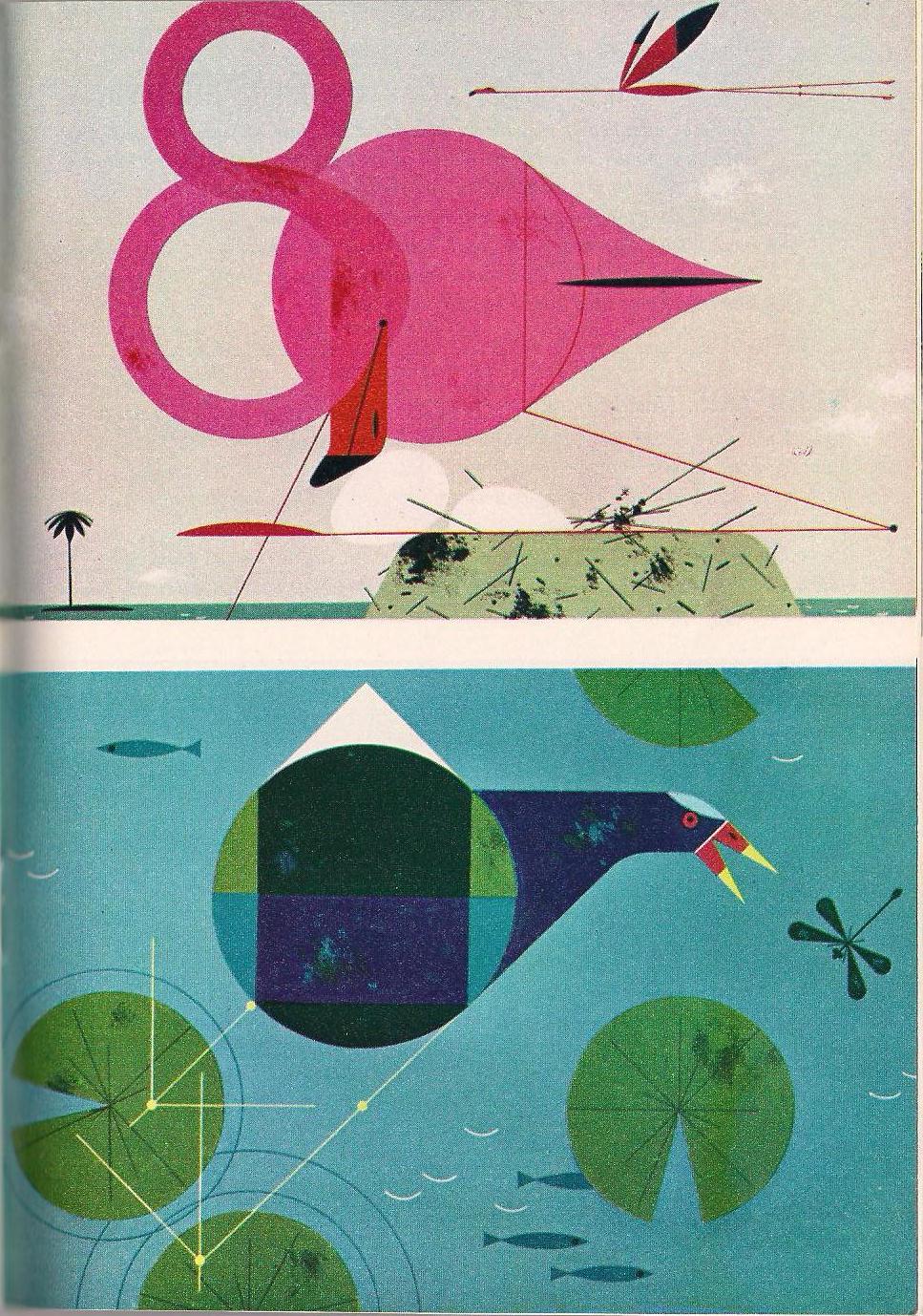
I do the blogging for a local gallery chain. We carry a lot of Charley Harper pieces (as in, the most in the world). Nine months ago, this would have meant absolutely nothing to me. Even though I’ve moved (mostly) in and (occasionally) out of the art world for the bulk of my adult life, I had barely heard of him before starting this gig. Back in “the day”-in this case the 1950s onwards-he did a lot of illustrations for a magazine called the Ford Times, which I had definitely never heard of. Even though I love old periodicals. (I think I can be forgiven for not reading old copies of a lifestyle magazine put out by the Ford Motor Company, right?) Anyway, I will try to wrap this up in a neat, figurative bow because, well, this is a diversion piece. As we know, in my universe, that constitutes a few sentences and a photograph or two. Moving on….
I met a delightful old man yesterday afternoon. After he found out that I sometimes write about Charley Harper, he gave me this excellently preserved copy of the Ford Times. Although I have seen most of the prints made from these illustrations, I had never seen the magazine before. I had no idea that it was so small! I thought that it was a full-sized periodical.
He didn’t just gift me with any Ford Times issue, but one that featured some of the images I have written about. I love the flying flamingo in the background of the top illustration.
This layout makes me want to go camping, badly. But only if I can have that awesome car and the sweet tent, which actually makes setting up camp look fun! This story alone made my day (I’m weird like that). Thank you, Mr. Old Man! Your gift is in good hands.
A Year in Books/Day 136: Starstruck
- Title: Starstruck
- Author: Jib Fowles
- Year Published: 1992 (Smithsonian Institution Press)
- Year Purchased: 1993?
- Source: Little Professor Book Center
- About: Jib Folwes would like to welcome you to Star Village, a term he coined to cover the 100 celebrities who, at any given time, receive the highest concentration of interest by the public. Although early 21st century forms-such as the Internet, YouTube, and reality television-have perhaps skewed the numbers and demographics, the foundation of his theory remains strong. He dissects every aspect of stardom, starting with how modern celebrity came to be, how it is achieved, maintained, and how, for some, it dies. He uses a cross-section of actors, musicians, comedians, and athletes, including: Louis Armstrong, Clara Bow, Doris Day, Buster Keaton, Billie Jean King, John Lennon, Liberace, Steve McQueen, Marilyn Monroe, Roy Rogers, Babe Ruth, Lawrence Welk and Mae West. It is a fascinating, almost sociological, look at a hierarchy we are born into, take for granted, and rarely seriously question.
- Motivation: I’m a sucker for old Hollywood. I also love the logic, research and data behind serious sociological studies, even when the subject is pop culture.
- Times Read: 2
- Random Excerpt/Page 75: “Viewed within the context of the twentieth century’s eruption of metropolitan living and machine production, the star phenomenon can be seen to have resulted from two historical imperatives. The need of uprooted city dwellers for personality models was compelling enough, but a second force-related yet distinct-was at work.”
- Happiness Scale: 9 1/2
Jib Fowles will tell you why, exactly, I became famous! (Photo of Lawrence Welk courtesy of Wikipedia)
A Year in Books/Day 134: What Jane Austen Ate and Charles Dickens Knew
- Title: What Jane Austen Ate and Charles Dickens Knew From Fox Hunting to Whist-the Facts of Daily Life in 19th-Century England
- Author: Daniel Pool
- Year Published: 1993 (Simon & Schuster)
- Year Purchased: 1994
- Source: A gift from an ex
- About: This book is history-light. Don’t get your knickers in a knot, as that is rarely a bad thing! Although I love weighty, intellectually demanding tomes like a kid loves candy, lighter fare inhabits its own cozy corner of my heart. It took awhile for that to happen. Even as a pre-teen, I was (perhaps unnaturally) concerned with running out of time in which to read the world’s literary classics. Yes, I truly thought about such things as an eleven-year-old. As I thought that time was-a-wastin’, I wasn’t about to devote my precious allotment to “lesser” reading. Eventually, I discovered history books of the pop culture variety. I ate volumes whole, on a variety of history-related topics: fashion, art, film, photography. This led me down the lovely, informative and fun path that is littered with books like What Jane Austen Ate and Charles Dickens Knew: well-researched, well-written and highly readable books devoted to popular and general history subjects. I have a preference for the Elizabethan and Victorian eras, with the Jazz Age coming in a very tight third. These are my idea of “beach reads”. Now, I’ll turn to the book at hand. Nearly every aspect of daily life that the average person could find interesting is discussed and dissected within its pages: etiquette, currency, society, marriage, kids, death, clothing, food, commerce, orphans, maids, “lesser folk”, crime, rural life, urban living, sex, balls, dinner parties, hygiene, occupations…..There is a handy glossary for those new to the era and its terms. Although not ground-breaking or revolutionary, it’s engrossing enough that it demands your attention from start to finish.
- Motivation: It was a gift from someone who was trying to woo me. Unfortunately, it worked (for a time) because, obviously, books are a way to my heart. This gift was so perfect that it blinded me to all common sense and logic. Or, so I’d like to think.
- Times Read: 2
- Random Excerpt/Page 134: “In England in 1800 one could be hanged for sheep stealing, sodomy, murder, impersonating an army veteran, stealing something worth more than five shillings from a shop, treason, doing damage to Westminster Bridge, and about two hundred other offenses. (Killing a man in a duel, although murder, was considered socially okay for people of quality, so juries generally didn’t convict until the 1840s. Thereafter it became advisable to duel on the Continent, as Phineas Finn does.)
- Happiness Scale: 9 1/2
Voices from the Grave #19: Ernest Hemingway
This week’s Voices from the Grave is a bit different: Hemingway isn’t reading anything. In fact, we don’t hear his voice at all. It’s :53 of stock footage of the American writer, with a voice-over by a nameless narrator. It is interesting in its own time-capsule-esque way.
The sportsman we have seen standing by the giant fish, the fallen lion.