"A writer never has a vacation. For a writer life consists of either writing or thinking about writing."-Eugene Ionesco
Reply
My newest obsession is making dough, of the pastry variety. I fully expect this to hang around long enough to become a genuine hobby, and not just a passionate passing fancy. I learned to bake things from scratch when I was 9. I made a cake under my aunt Lauree’s supervision. It was a Cocoa cake from a Betty Crocker dessert cookbook. You finished it off by dusting it with confectioner’s sugar. It turned out well. I was immensely delighted by my creation: I have been baking ever since.
I always shied away from pie crust. I considered that to be part of my Grandmother’s realm. Like most Midwestern families, pie is integral to gatherings and celebrations. My grandmother–and her mother before her–is the queen of pastry. It honestly never occurred to me to bake a pie, until a few weeks ago. I was slightly bereft over my inability to attend an important family function: 6 hours was simply too great a distance to travel that day. Sitting at home, in my writing chair, sipping a cup of tea, I started musing on all of the delectables that I could possibly be missing. Pie came in at the top of the list. As it is summer, my dreaming naturally settled on a rhubarb pie, that creature of warm weather get-togethers. I could not shake this desire.
After several days, it slowly, and with some effort, dawned on me that I could, of course, as a grown woman, bake my own damn pie. Decision made. I baked two pies, home-made all of the way. They turned out better than I envisioned. The crust was flaky, the topping was crisp, the flavour was that special blend of sweet-sour unique to rhubarb pie. I also made a different crust for empanadas that night, as I have done several times since then.
There is a meditative quality to mixing pie crust with your fingers, a quality of serene precision in rolling it out. I was surprised to feel a pull of the artistic in the process. That thrill you get by making something with your hands was duly present. As a writer, I am constantly plying my craft, in as many forms and venues as my brain, creativity and schedule can allow. This is draining. It can easily suck away vitality from other parts of your life, until you are entirely enervated. This can result in all of my drive–including that which compels me to write–disappearing. In order to keep myself artistically in balance, I try to find hobbies to keep my muse agile. I believe that creativity (of any kind) begets further creativity; it all serves to pipe new blood into my writing. It keeps my mind elastic without actively taxing my literary nature. Creativity is to be found in so many places, most of them entirely unexpected.
I have done counted cross-stitch, on and off, since I was in elementary school. It taxes my bad eye-sight, so I have imposed a 30-minute limit on the endeavour. I have finished 2 pieces in the last 2 1/2 years, both given as gifts. I am about to embark on a new design in a few weeks, an ambitious Elizabethan pattern. It will take me months, if I dole out my time in dribs and drabs. It requires physical dexterity that is so different from writing. Following a pre-determined grid frees my mind to think about other things, or nothing at all. When I complete needlework, there is an immediate gratification that is not present when I finish a story or article. There is no more to do; it is done. I don’t have to rethink anything or put myself through mental hoops, round after round after round. It is self-contained. There is no need to return to it weeks, months later to see if it needs to be reworked.
While having a consistent writing routine is integral to your art, it is important to have outside pursuits to occupy your mind. That kind of mental and imaginative curiosity ultimately benefits your words, your plots, your characterizations. I am entranced by so many things. I used to constantly engage in the “someday game”. Someday I will learn how to speak Norwegian, someday I will start making collages, someday I will learn how to bake pies. I still fall into that trap all too frequently but now I make a genuine effort to cordon off time for those things that even remotely interest me. Not everything works out to the point of becoming a viable hobby, yet many do. I finally know what it feels like to be covered in flour from rolling out a pastry crust; and it feels like home. Next stop: learning more than 5 phrases in Norwegian. My words will thank me.
The bad news: the tactile version of Amelia’s Magazine is no longer available. The good news: it has been restructured as a blog, and an illustration anthology is in the works. The brainchild of, yes, a woman named Amelia, it survived in its original form for 5 years. There were 10 amazing issues. Though we must now content ourselves with the on-line incarnation, it is more a sacrifice of spirit than content. This is , for me, the hidden thorn.
This luxurious, artistic gem of a magazine was founded on true small-press principles, with passionate intent to be old-school three-dimensional. In other words, paper. It featured art, fashion, the environment , photography, and music (the first issue had an interview with pre-train wreck Pete Dougherty). There was something to satisfy every art-conscious person, and it was beautifully presented. I realize that the founder’s ideals have not altered. Amelia herself, on the blog, refers to is as “creativity in the climate of change”: that is a heart-rending encapsulation of the world that artists ,and all of us, currently face.
It is true that Amelia’s Magazine was home-grown but it was a glossy, potent and professional product. She invested real money into the endeavour and, where there is money to be gained, there is also money to be lost. In this sense, it was not really a kitchen-table affair (KTA) but the relatively expensive, sophisticated product of an artist with access to real resources, something that most of us lack. This at once elevated the publication into the realm of the big boys. An indie magazine playing on a real stage. This is impressive and is, perhaps, at the heart of what every creative renegade hopes to achieve: Independence, readership and respect. Another lesson to be learned here is how building a network of like-minded artists can pay off for all involved.
The blog is not to be trifled with or dismissed: it retains much of what made the hard copy so invigoratingly delicious. There is a core of savvy contributors, beautiful or eye-opening pieces (reviews, interviews) and an atmosphere electric with creativity and respect for all of the kaleidoscopic artistry to be found in our sometimes frustrating, ever-altering modern world. Amelia’s Magazine’s passionate, particularly English approach to the arts is still here, just in a different form. Knowing where the blog sprang from can give the briefest pause, as you stop to mourn ,with genuine grief, the old-school ideals that first gave it life. Meeting the demands of the economic and artistic moment means tangling with compromise. The end result is , perhaps, not all that one would hope for: yet, the willingness of Amelia and her staff to engage in some shape-shifting has ensured that it will remain with us for some time to come.
I am having some problems with linking things. Actually, the links work properly but, even though it is set up correctly, it is not highlighting the links. So, to go directly to the site, simply click on the first place that it says “Amelia’s Magazine” at the top of the page. Thanks!

I am a notorious slut-glutton for words. The favoured objects of my affection have always been, and remain, reference books. I devoured them from early childhood on, even reading dictionaries on car-trips. I cannot look up a word without reading several pages worth of entirely irrelevant definitions. As a writer, this obsession comes in handy: reference books are, or should be, our dearest associates. I own a slew of them: dictionaries, encyclopedias, volumes on style and grammar, miscellaneous fact-books, how-to’s, market tomes. It is easy to be overwhelmed by the escalating mountain of reference-for-writers material.
The best way for someone like me to avoid the siren’s song of reference books is to be exceedingly picky. If a volume is not enlightening, inspiring or practical with an interesting spin then I simply refuse to bring it home. I think that these guidelines are appropriate for any writer to follow. The “Useful Reads” column will spotlight books that have passed my stringent rules: as such, I am happy to recommend them for your use.
I am a savvy, technology-aware writer. I realize that the Internet exists. I realize that search engines are marvelous, time-saving niches: I use them frequently. They are, in their limited capacity, addicting. Nothing, however, beats the tactile pleasure of picking up a hefty book, balancing it on your knees, and idly or hurriedly flipping through its pages. You know that, eventually, you will find what you are looking for, and many other fantastical things besides.
The New York Public Library Desk Reference is the perfect volume for all of your fact-finding-or-affirming needs.It is laid out in neat, easy-to navigate chapters. It covers much of the same ground that you would find in an encyclopedia without the lengthy entries: it is precise, detailed, and to-the-point yet it is more all-encompassing than a regular almanac. It calls itself “The most valuable answer book you will ever own”, which is certainly an accurate assessment. But be forewarned: it is definitely a traditional read . If you are looking for irreverent, dark or odd factoids, then you are better off picking up a copy of that wee gem, Schott’s Original Miscellany.
With the famous stone lions decorating the outside, it touches upon everything from Frost Dates to Popes, Wine Selection to Royalty. As with any reference book worth its list price, it sucks me in every time that I open the covers. The New York Public Library is staffed with professionals who know there stuff better than anyone in the business. They have distilled that knowledge into roughly a thousand pages of practical information. Finding exactly the fact or figure that you need can be done with immense speed, and in less time than searching the Web would require. As long as you do not let yourself get carried away into mini-raptures of new-found but irrelevant wisdom, as I am apt to do (“What is this? A list of diacritical marks? Heaven!”), this can be a critical tool in allowing you to devote less time to research, and more for writing. Unless, of course, you are a word-fact geek like me, wherein meandering through the pages is half of the point, and all of the pleasure.
I am not a great writer of place. This is not laziness : it is a real necessity if I am to give birth to my particular vision. In order to make way for the intimately universal, I do not set my fiction in instantly recognizable locales, nor is any regional influence obvious. My characters do not speak in dialect, do not exhibit traits characterized by a specific city or state. They are merely, inescapably human: a condition experienced by every soul the world over. There is atmosphere and description to be found in my stories but they are peculiar to individuals and their personal surroundings: there is no wider, deeper imprint of place. I respect and enjoy many writers who are profoundly connected to their home turf, and carry it into their work: Austen, Joyce, Faulkner. The passion and intensity that they imbued their novels with remains a strong pull across the tumble of so many years. Yet, a lack of specificity can be an equal lure for readers, and this is what I attempt with my words, however humble. The drive behind what I do, and how I approach the career that presents my artistry to the light, is another matter: it is an unbreachable combination of the local and the universal, and always as grassroots as possible.
The Internet has opened up a heretofore unimaginable amount of venues for the selling, marketing and discourse of artistic product. What someone writes in Russia can be read in North Dakota as soon as a button is pressed. The possibility is breathtaking and would, likely, be unfathomable to the writers of even 50 years ago. This means that networking can be done on a scale as vast as the world itself. You can, with surprising ease, craft a sounding board or support group made up of individuals of many nations without ever going through the hoops of old-fashion and exhausting legwork. This may sound impersonal but it can be truly valuable, and genuine connections can be formed. Yet to use this as the sole means of contact ,and the only form of self-promotion, is sadly limiting. At the heart of it, nothing surpasses getting your hands dirty at a local level–the place where, perhaps, the most difference is to be made. This kind of approach is my life’s passion, next to the actual act and offering of writing itself. I am enraptured with words, in love with history and dedicated to thanking those who came before me. I will briefly boil this amalgam down to the bone: Small press literary publications were the unheralded backbone of American and European literature in the earliest decades of the 20th-Century. They were a mouthpiece to some of the finest efforts of writers great and small; writers whose poetry, essays, critiques and stories would otherwise not have been published regularly or at all. These artist-helmed publications were their way to immortality, even if they did not know it at the time. Combining the above elements is where my devotion to the local becomes active.
While working for a Columbus-based art-and-culture start-up a few years back, my passions turned to convictions, and from there ideas sprang into being. One of the things that I set out to do as Literary Editor of The Atomic Tomorrow was to turn many of the pages over to the work of local writers, of all ages, genres, and voices. I was honoured to give others the same chance that I received, and continue to receive so generously from various sources. The literary section of that paper gave seed to what I am attempting to do with A Small Press Life and the ‘zine that I have in production.
While I love blogging and lending my work to other on-line publications, where there is a true sense of community, I enjoy the change and challenge of crafting something from the ground up and then physically putting it together. In our techno-sated world, there is almost a sense of rebellion, even anarchy, in laying out, printing, and hand-assembling a magazine or book. The artistry seems to be of a higher order, and the satisfaction is beyond anything to be gained from hitting a “Publish Post” button. When done by professionals, especially, the end-product can be a masterly gem of vision, talent, and individuality. Zining is, for me, the perfect balance and blend of the modern and the classic.
There is something lovely and primal about creating a ‘zine: the process, for me, is an organized yet organic exploration of what I am capable of. It stretches my talent in new directions. I do not indulge in the awkward, car-wreck known as the perzine, which is a glorified diary. I gather art and writing from my always-expanding circle of professional creative friends. My ‘zines are a breathing, pulsing tribute to those little Literary Magazines mentioned-above, on a scale not significantly smaller than those put-out by my mentor-muses. The advantages of modern technology walk into the picture after an issue has been completed.
The wonders of Etsy and Papernstitch, coupled with electronic word-of-mouth, are the best free-marketing-and-selling venues available for hand-made goods. Your product reaches around-the-globe almost instantaneously. You can have fans in Australia or Iceland, without actively advertising there. I am an enthusiastic proponent of this concept: the local-gone-global. Still, nothing beats the giddy, visceral thrill of placing your work in your own city. Whether it be at a coffee shop or farmer’s market, having something that I have worked so diligently at and for available in my own neighborhood is the biggest kick of all. These outlets will always be vital to my art: spreading it locally is always a heightened accomplishment.
I do not imagine, at this time, that I will drastically change course and become a writer of local colour and inflection. That is not a goal that I embrace: doing so would seem oddly foreign to my voice and viewpoint. I remain, however, a daughter-in-spirit to this place:I truly love Ohio’s artistic urban vibrancy, and am proud to call the Buckeye state my home. We have both an outstanding artistic heritage and a lively, forward-thinking present. I choose to embody those ideas where the difference is greatest–through my actions, convictions, and life-style–rather than on the page. This way, my words and life are local-global, and remain my own.
This is the first of many new elements that will be added over the next few weeks. Every weekend, I will be sharing with you some of the eclectic things that inspire me, both as a writer and person: after all, the two are completely fused. Artists of the visual variety are famously inspired by all manner of things. I believe that this holds true for every creative, including writers. While the words, deeds, and lives of other wordsmiths certainly help goad one on in the hope department, ideas often arise from the most random, unexpected sources. Some of these muses run a true and constant course, providing you with a steady stream of encouragement and fecundity. Others dash in front of you, inspiring a passionate moment or two before flitting out of your mind. Anything that encourages you to pick up the tools of your trade and get creating is valid and luminous. On this week’s board:
“I love you without knowing how or when, or from where.
I love you straightforwardly, without complexities or pride;
so I love you because I know no other way.”
from “SONNET XVII” by Pablo Neruda
I just re-discovered the novel “Depths of Glory” by Irving Stone, historical fiction about my favourite Impressionist, Camille Pissaro. I read it as a teen and plan on borrowing my mom’s copy in order to dive back into the excellently re-created world of 19th-century French art.
“I can always be distracted by love, but eventually I get horny for my creativity.”-Gilda Radner (1946-1989).
My newly realized passion for making dough.
The culinary chutzpah of every-man Andrew Zimmern. I am addicted to “Bizarre Foods.”
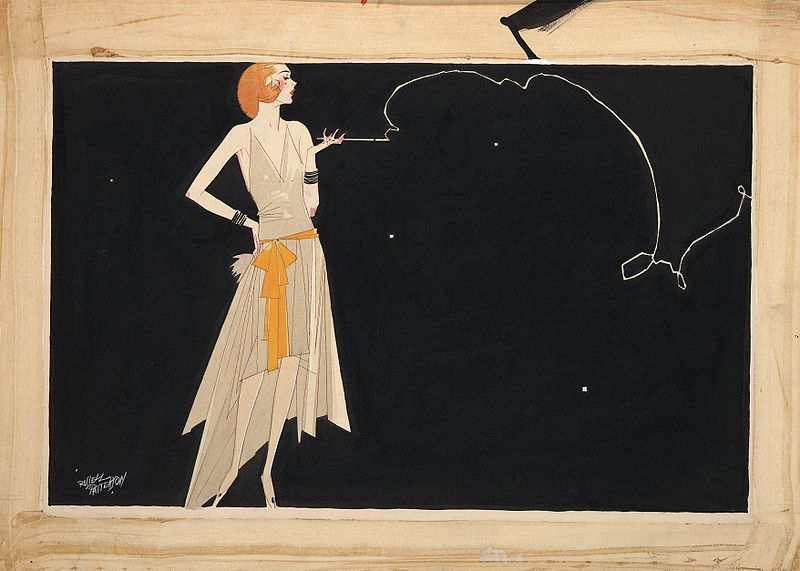
The image at the top of the page: “Where there’s smoke there’s fire”, a 1920’s painting by Russell Patterson. I love how the colour of the sash is a near-perfect match to her hair. The cut and drape of the frock is still fashionable, and still contemporary. It is all-too-easy for me to create dreamy confectionery back-stories to art like this.

 A Small Press Life: Books. Art. Writing. Life. Tea.