For writers, there is no such thing as shop-talk. What we do cannot be separated from who we are, cannot be compartmentalized into its own box. It is as expansive and necessary as breathing or blinking. Therefore, we can be very wordy when the subject at hand turns to our words. Whether we are discussing the technical (the fundamental underpinnings of an article or story) the personal (plot, characterization, voice) or the idiosyncratic (writing patterns, philosophy), we can go on and on, until our passion invokes boredom or annoyance in any non-writer listeners. This is not something that can be easily turned off, or satisfied with a quick “this is how my day went” briefing. Yet, speaking to someone who is not engaged in the writing life can often result in feelings of impotence, frustration, and misunderstanding. Explaining why you write is either the easiest or toughest thing in the world, depending on who is at the other side of the conversation.
My significant other–The Chef–is smart, astute, and possesses a large vocabulary. He recognizes my talent but does not begin to know the need I have to write, what it is that compels me to maintain such loyalty and dedication to something that is so hard-to-focus or pin-down. There is nothing immediate to show for writing except words on a page: concrete gratification is often long-delayed and far-short of what, seemingly, such hard work deserves. This is why the writing life is one of such abiding, enveloping loneliness; for who, but another writer, can begin to approach any coherent, compassionate understanding of what it is we do?
The Glimmer Train Guide to Writing Fiction Inspiration and Discipline Edited by Susan Burmeister-Brown and Linda B. Swanson-Davies is a squat little window into the strange, amorous and often isolated world of the writer. To be a writer is always to be the oddest person in a room. You could be surrounded by a bearded lady, a fire-eater, a con artist and a hobo, and chances are that you will be the one to come off as a childish slacker. It goes, however unfairly, with the territory. You eventually become accustomed to being viewed as a dreamer with unrealistic expectations by your nearest and dearest: trying to explicate the inner drive to write is simply too difficult.
Reading The Glimmer Train–made up of interviews from Glimmer Train Stories–is like having fabulous, enlightening, and intimate chats with your peers. Although I leaned a few pointers, the book is, for me, not so much a how-to of the writing game but a how-to-survive-the-writing-life guide. It cuts a deep swathe through the layers of isolation and misunderstanding inherent in such a lifestyle. It is sated with words of wisdom, humour, hope and shared perspective.
The interviews are served up, bite-sized, covering all manner of subjects: technique, inspiration, family, art, lifestyle, support, to name a few. What becomes apparent after a few pages is how much in common they–and we–have, in spite of differences in gift, genre,voice, and approach. Almost everyone, it seems, writes because they have no choice, because they cannot imagine not writing, because they are compelled to from some deep and unknowable source. They would write even if no one ever read their words.
The instructional part, for me, was in seeing how different writers approach the immensely painful, lonely, yet joyous task at hand; to see how they discipline themselves to do what is just damn hard work, day in and day out. Aside from that, nearly every page contains multiple gems, presents alternate but easy-to-relate to ways of thinking.
Perhaps the most impactful bit of advice, for me personally, comes from Richard Bausch, of whom I had never before heard. Instead of thinking of writing as an uprooting –of digging things up from deep within–he envisions it as a winding path, endless, where anything can present itself to you. I find that to be beautiful, insightful, doable.
This is a must-have for any writer ever in need of inspiration, understanding, or a pep-talk. It is always within reach of wherever I happen to be writing; it is also often to be found on my bedside table. I know that you, too, will find it well-worth the small investment involved.
I plan on showing the book to The Chef, with the hope that it will help to explain where I am coming from, as reader-writer. I believe that seeing such strong, plain, passionate words out of the mouths of others who share my obsessive sentiments will serve the purpose far better than I could. If, however, that does not work, The Glimmer train will at least provide me with a happy haven.
Author Archives: maedez
INSPIRATION BOARD-14 July 2009
After a long-weekend off–my very own home-town-bound mini-holiday–I am struggling to get back into the swing of things. I have not hit the ground running. I have been standing idle, craning my neck, trying to find something,anything, to crank my motivation up a notch or three. My mind is teeming with a thousand big, a million little, ideas. Settling down long enough to commit more than an errant, squirming phrase or two to paper is proving immensely difficult. Spending uninterrupted, calming quality time with family has reminded me to look to the small things for succor and inspiration. I am going to try and apply that lesson to my creativity. Here are a few things that are currently making me think, smile, and give thanks.
- A cuppa and a few McVitie’s chocolate digestives make me feel not just like a writer, but an English one. I do not indulge in the latter very often but very few things beat their peculiar and scrumptious wheat-meets-sweet taste.
- The ridiculously vibrant and exotic produce section at Jungle Jim’s, a gourmet, international grocery emporium in Cincinnati. They stock an eye-opening variety of vegetables and fruits. I love the artistry of the display; it is a visual reminder that nature’s bounty is varied and endless.
- “We do not write because we want to; we write because we have to.”-words of infinite wisdom from one of my favourite authors, W. Somerset Maugham.
- Anticipating the August (Age) issue of ‘Vogue’. All fashion magazines manage to simultaneously elate me and flat-out piss me off. This is cyclical; this is perpetual. My love of fashion-as-history runs deep. I also love pretty, pretty pictures (something that modern Vogue does not always deliver). I still adore the issue’s cover girl, Christy Turlington, who remains as stylish, elegant and principled as ever. Plus, the ‘Age’ issue of the magazine always exists on the sharpest razor’s edge, waffling between dishing out genuine inspiration and gutless irritation.
- Discovering, after all of these years, that I have more in common with my Dad than just a high IQ and love of reading.
- Writing that is utterly unlike my own. Whilst in the midst of much creative writing, I can only read non-fiction or fiction that has a voice and view-point far removed from mine. I am beyond excited that my friend Chrissy has finally started her own blog, A Steampunk Reverie.. Please check it out, you won’t regret it: Click here to begin.
- Baseball’s All-Star Game. It is held the second Tuesday of July (tonight!), which is always around my birthday. In my mind, the two simply go together. I can scarcely recall a time that I was not a baseball fan. I owe this particular passion to my Grandfather. The game, held this year in St. Louis, is, for me , a hallmark of Summer, relaxed times, and family.
"A writer never has a vacation. For a writer life consists of either writing or thinking about writing."-Eugene Ionesco
Alicia’s Adventures in ‘zining: Why oh why? or: Getting Started
INSPIRATION BOARD-6th July 2009
- “Fight Club” (1999)-I love Chuck Palahniuk’s writing, probably because it is so different from mine. I finally got around to watching the film adaptation of his 1996 novel just last week. The experience was definitely helped along by a few glasses of wine. Talk about jumping on the bandwagon ridiculously late, but it is a a satisfying film that has done an admirable job of sticking with me.
- Farmer’s Markets. I wish that there was one in my neighborhood but, alas, I shall have to seek one out. Shopping the stalls is a sign that Summer is in its magnificent full-swing.
- Marion Cotillard’s look in “Public Enemy”. The French actress has an almost non-pareil ability to fit seamlessly into period films. Not only does she wear the clothes superbly, but she looks as if she is comfortably of that time. This is the only film that I really want to see this Summer.
- “Writing is its own reward.”-Henry Miller. This is a simple, effective reminder about something that is so easy to forget.
- The Greek Myths: 1 by Robert Graves. Greek Mythology is complex, potent, compelling and incredibly entertaining–everything that fiction should strive to be. Mythology is a complicated mixture of history, religion, fiction and sociology that we can learn much of the story-telling craft from. I also love Graves’ approach. Reading about the Greeks always makes me excited about the possibilities of story and characterization.
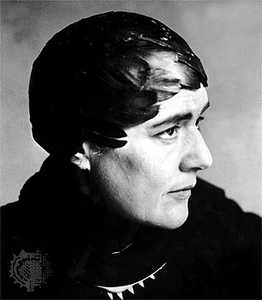
- The above photograph of Ohio-born writer Fannie Hurst is, for me, the epitome of the elegant, intelligent early-20th Century female writer. One could craft innumerable fictions around that image.
The Creative Effect
My newest obsession is making dough, of the pastry variety. I fully expect this to hang around long enough to become a genuine hobby, and not just a passionate passing fancy. I learned to bake things from scratch when I was 9. I made a cake under my aunt Lauree’s supervision. It was a Cocoa cake from a Betty Crocker dessert cookbook. You finished it off by dusting it with confectioner’s sugar. It turned out well. I was immensely delighted by my creation: I have been baking ever since.
I always shied away from pie crust. I considered that to be part of my Grandmother’s realm. Like most Midwestern families, pie is integral to gatherings and celebrations. My grandmother–and her mother before her–is the queen of pastry. It honestly never occurred to me to bake a pie, until a few weeks ago. I was slightly bereft over my inability to attend an important family function: 6 hours was simply too great a distance to travel that day. Sitting at home, in my writing chair, sipping a cup of tea, I started musing on all of the delectables that I could possibly be missing. Pie came in at the top of the list. As it is summer, my dreaming naturally settled on a rhubarb pie, that creature of warm weather get-togethers. I could not shake this desire.
After several days, it slowly, and with some effort, dawned on me that I could, of course, as a grown woman, bake my own damn pie. Decision made. I baked two pies, home-made all of the way. They turned out better than I envisioned. The crust was flaky, the topping was crisp, the flavour was that special blend of sweet-sour unique to rhubarb pie. I also made a different crust for empanadas that night, as I have done several times since then.
There is a meditative quality to mixing pie crust with your fingers, a quality of serene precision in rolling it out. I was surprised to feel a pull of the artistic in the process. That thrill you get by making something with your hands was duly present. As a writer, I am constantly plying my craft, in as many forms and venues as my brain, creativity and schedule can allow. This is draining. It can easily suck away vitality from other parts of your life, until you are entirely enervated. This can result in all of my drive–including that which compels me to write–disappearing. In order to keep myself artistically in balance, I try to find hobbies to keep my muse agile. I believe that creativity (of any kind) begets further creativity; it all serves to pipe new blood into my writing. It keeps my mind elastic without actively taxing my literary nature. Creativity is to be found in so many places, most of them entirely unexpected.
I have done counted cross-stitch, on and off, since I was in elementary school. It taxes my bad eye-sight, so I have imposed a 30-minute limit on the endeavour. I have finished 2 pieces in the last 2 1/2 years, both given as gifts. I am about to embark on a new design in a few weeks, an ambitious Elizabethan pattern. It will take me months, if I dole out my time in dribs and drabs. It requires physical dexterity that is so different from writing. Following a pre-determined grid frees my mind to think about other things, or nothing at all. When I complete needlework, there is an immediate gratification that is not present when I finish a story or article. There is no more to do; it is done. I don’t have to rethink anything or put myself through mental hoops, round after round after round. It is self-contained. There is no need to return to it weeks, months later to see if it needs to be reworked.
While having a consistent writing routine is integral to your art, it is important to have outside pursuits to occupy your mind. That kind of mental and imaginative curiosity ultimately benefits your words, your plots, your characterizations. I am entranced by so many things. I used to constantly engage in the “someday game”. Someday I will learn how to speak Norwegian, someday I will start making collages, someday I will learn how to bake pies. I still fall into that trap all too frequently but now I make a genuine effort to cordon off time for those things that even remotely interest me. Not everything works out to the point of becoming a viable hobby, yet many do. I finally know what it feels like to be covered in flour from rolling out a pastry crust; and it feels like home. Next stop: learning more than 5 phrases in Norwegian. My words will thank me.
"The trade of authorship is a violent and indestructible obsession."-George Sand
Love at First Site: Amelia’s Magazine
The bad news: the tactile version of Amelia’s Magazine is no longer available. The good news: it has been restructured as a blog, and an illustration anthology is in the works. The brainchild of, yes, a woman named Amelia, it survived in its original form for 5 years. There were 10 amazing issues. Though we must now content ourselves with the on-line incarnation, it is more a sacrifice of spirit than content. This is , for me, the hidden thorn.
This luxurious, artistic gem of a magazine was founded on true small-press principles, with passionate intent to be old-school three-dimensional. In other words, paper. It featured art, fashion, the environment , photography, and music (the first issue had an interview with pre-train wreck Pete Dougherty). There was something to satisfy every art-conscious person, and it was beautifully presented. I realize that the founder’s ideals have not altered. Amelia herself, on the blog, refers to is as “creativity in the climate of change”: that is a heart-rending encapsulation of the world that artists ,and all of us, currently face.
It is true that Amelia’s Magazine was home-grown but it was a glossy, potent and professional product. She invested real money into the endeavour and, where there is money to be gained, there is also money to be lost. In this sense, it was not really a kitchen-table affair (KTA) but the relatively expensive, sophisticated product of an artist with access to real resources, something that most of us lack. This at once elevated the publication into the realm of the big boys. An indie magazine playing on a real stage. This is impressive and is, perhaps, at the heart of what every creative renegade hopes to achieve: Independence, readership and respect. Another lesson to be learned here is how building a network of like-minded artists can pay off for all involved.
The blog is not to be trifled with or dismissed: it retains much of what made the hard copy so invigoratingly delicious. There is a core of savvy contributors, beautiful or eye-opening pieces (reviews, interviews) and an atmosphere electric with creativity and respect for all of the kaleidoscopic artistry to be found in our sometimes frustrating, ever-altering modern world. Amelia’s Magazine’s passionate, particularly English approach to the arts is still here, just in a different form. Knowing where the blog sprang from can give the briefest pause, as you stop to mourn ,with genuine grief, the old-school ideals that first gave it life. Meeting the demands of the economic and artistic moment means tangling with compromise. The end result is , perhaps, not all that one would hope for: yet, the willingness of Amelia and her staff to engage in some shape-shifting has ensured that it will remain with us for some time to come.
I am having some problems with linking things. Actually, the links work properly but, even though it is set up correctly, it is not highlighting the links. So, to go directly to the site, simply click on the first place that it says “Amelia’s Magazine” at the top of the page. Thanks!
Useful Reads: The New York Public Library Desk Reference
I am a notorious slut-glutton for words. The favoured objects of my affection have always been, and remain, reference books. I devoured them from early childhood on, even reading dictionaries on car-trips. I cannot look up a word without reading several pages worth of entirely irrelevant definitions. As a writer, this obsession comes in handy: reference books are, or should be, our dearest associates. I own a slew of them: dictionaries, encyclopedias, volumes on style and grammar, miscellaneous fact-books, how-to’s, market tomes. It is easy to be overwhelmed by the escalating mountain of reference-for-writers material.
The best way for someone like me to avoid the siren’s song of reference books is to be exceedingly picky. If a volume is not enlightening, inspiring or practical with an interesting spin then I simply refuse to bring it home. I think that these guidelines are appropriate for any writer to follow. The “Useful Reads” column will spotlight books that have passed my stringent rules: as such, I am happy to recommend them for your use.
I am a savvy, technology-aware writer. I realize that the Internet exists. I realize that search engines are marvelous, time-saving niches: I use them frequently. They are, in their limited capacity, addicting. Nothing, however, beats the tactile pleasure of picking up a hefty book, balancing it on your knees, and idly or hurriedly flipping through its pages. You know that, eventually, you will find what you are looking for, and many other fantastical things besides.
The New York Public Library Desk Reference is the perfect volume for all of your fact-finding-or-affirming needs.It is laid out in neat, easy-to navigate chapters. It covers much of the same ground that you would find in an encyclopedia without the lengthy entries: it is precise, detailed, and to-the-point yet it is more all-encompassing than a regular almanac. It calls itself “The most valuable answer book you will ever own”, which is certainly an accurate assessment. But be forewarned: it is definitely a traditional read . If you are looking for irreverent, dark or odd factoids, then you are better off picking up a copy of that wee gem, Schott’s Original Miscellany.
With the famous stone lions decorating the outside, it touches upon everything from Frost Dates to Popes, Wine Selection to Royalty. As with any reference book worth its list price, it sucks me in every time that I open the covers. The New York Public Library is staffed with professionals who know there stuff better than anyone in the business. They have distilled that knowledge into roughly a thousand pages of practical information. Finding exactly the fact or figure that you need can be done with immense speed, and in less time than searching the Web would require. As long as you do not let yourself get carried away into mini-raptures of new-found but irrelevant wisdom, as I am apt to do (“What is this? A list of diacritical marks? Heaven!”), this can be a critical tool in allowing you to devote less time to research, and more for writing. Unless, of course, you are a word-fact geek like me, wherein meandering through the pages is half of the point, and all of the pleasure.