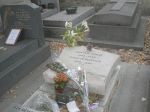
Poetic Grief

My husband’s Aunt died today. After soothing his immediate grief, the first thing my mind turned to was poetry, death poetry: one of the three essential subjects of literature (and life), along with birth and love. Every poet that I can think of has touched on the theme, often numerous times. This is a piece by Rainer Maria Rilke, offered here as a lovely and sad filler whilst we deal with more pressing events.

‘On Hearing of a Death’ by Rainer Maria Rilke

We lack all knowledge of this parting. Death
does not deal with us. We have no reason
to show death admiration, love or hate;
his mask of feigned tragic lament gives us

a false impression. The world’s stage is still
filled with roles which we play. While we worry
that our performances may not please,
death also performs, although to no applause.

But as you left us, there broke upon this stage
a glimpse of reality, shown through the slight
opening through which you disappeared: green,
evergreen, bathed in sunlight, actual woods.

We keep on playing, still anxious, our difficult roles
declaiming, accompanied by matching gestures
as required. But your presence so suddenly
removed from our midst and from our play, at times

overcomes us like a sense of that other
reality: yours, that we are so overwhelmed
and play our actual lives instead of the performance,
forgetting altogether the applause.

A Year in Books/Day 10: The Filmgoer’s Companion

Lars Hanson

Image via Wikipedia

  • Title: The Filmgoer’s Companion Third Edition
  • Author: Leslie Halliwell (with a Foreword by Alfred Hitchcock)
  • Year Published: 1970 (Hill and Wang New York)
  • Year Purchased: 1990’s
  • Source: Antique Building, The Ohio State Fair
  • About: A dense, 1,072 page listing of nearly every player in movie history (up to the 1960’s), complete with pertinent biographical and career data, this is an info junkie’s dream. There is nothing extraneous, with Halliwell offering up facts and not opinions.
  • Motivation: I love old movie stars, especially those of the once-famous-now-obscure variety. For this reason, I collect vintage fan magazines and out-of-print, pre-1990’s genre books. Every cinema buff should own one edition of ‘The Filmgoer’s Companion’.
  • Times Read: 2
  • Random Excerpt/Page 7: “Speaking personally, I don’t know whether it is more flattering or disturbing to find oneself pinned down like a butterfly in a book which recounts all the macabre details of one’s career. But being a stickler for detail myself, I must, and do, submit; and I wish the enterprise well.”
  • Happiness Scale: 10+++ (although IMDB is splendid, sometimes only a book will do)
    English: Studio publicity photo of Alfred Hitc...

    Image via Wikipedia


Voices from the Grave-Some Words of Introduction

Reading is thought of as a silent pursuit, a psychic communion between two intellects and imaginations: those of author and reader. Yet, the space between those points is filled with a cacophony of phantom voices; characters go about their business as they would in the real world: shouting, whispering, crying, laughing. Your voice, too, is heard, as you process your own ideas and opinions. The quiet, firm mastermind behind the subtleties of plot and style is there, guiding everything behind a mask of neutrality: gagged by choice but interacting with everyone, across an expanse of space and time that refuses to be confined.

If you have ever been to a book reading you know what a wonderful experience it is to hear a writer read from one of their works. Maybe their words have been echoing for years in your head, until the only voice associated with them is your own. Hearing them spoken by the person who strung them together in such a serendipitous way may be jarring or amazing, at first, but surely it is always exhilarating. When many of your favorite authors are of the long-dead variety, setting off to the neighborhood Barnes & Noble for a Thursday night listen-and-greet is out of the question.

If we cannot travel back to the 1920s to catch Edna St. Vincent Millay on one of her famous speaking tours, or to the 1960s to hear Sylvia Plath give a radio reading, we can do the next best thing. That realm-of-nearly-all-things-are-possible, the Internet, is accessible with a few clicks of the keyboard. We are going to gather our favorite clips of writers speaking and permanently park them right here, under the auspices of ‘Voices from the Grave’.

First up: Robert Graves.

The Dead Writers Round-Up: 9th-13th January

Gallery

This gallery contains 7 photos.

Simone de Beauvoir was born on 1/9/1908. “Art is an attempt to integrate evil.” Katherine Mansfield died on 1/9/1923. “Could we change our attitude, we should not only see life differently, but life itself would come to be different.” Countee … Continue reading

A Year in Books/Day 9: The Greek Myths: 1

  • Leighton depicts Hermes helping Persephone to ...

    Image via Wikipedia

    Title: The Greek Myths: 1

  • Author: Robert Graves
  • Year Published: First Published 1955/Reprinted 1969 (Penguin Books)
  • Year Purchased: 2009
  • Source: Goodwill
  • About: This detailed and highly readable re-telling of various Greek myths almost reads like a compelling biographical dictionary.
  • Motivation: As a child, I fell in love with Greek mythology. The adventures of the gods and goddesses, and the mortals (un)lucky enough to be consumed by their passions, seemed the natural next step along from fairy tales. Also: Robert Graves. I’m always happy to read anything he wrote. With nearly 150 published texts to his credit, I regularly stumble over ‘new’ works by this long-dead master.
  • Times Read: 1
  • Random Excerpt/Page 131: “Enraged because Zeus had confined their brothers, the Titans, in Tartarus, certain tall and terrible giants, with long locks and beards, and serpent-tails for feet, plotted an assault on Heaven. They had been born from Mother Earth at Thracian Phlegra, twenty-four in number.”
  • Happiness Scale: 10 (for warm, fuzzy childhood memories and because mythology is better than any soap opera or reality program)

A Year in Books/Day 8: At Home A Short History of Private Life

  • Tea-Drinking. 1903

    Image via Wikipedia

    Title: At Home A Short History of Private Life

  • Author: Bill Bryson
  • Year Published: 2010 (Doubleday)
  • Year Purchased: 2010
  • Source: History Book Club
  • About: In the author’s words, he set out to “write a history of the world without leaving home”. He accomplished this by equating the rooms in a typical Victorian home with their worldly counterparts (i.e. the bedroom=sex, the bathroom=hygiene).
  • Motivation: I love Bill Bryson. ‘A Short History of Nearly Everything’ and ‘Bryson’s Dictionary of Troublesome Words’ are well-worn personal favorites. I am also a sucker for Victorian history; anything with a sociological aspect easily catches my fancy.
  • Times Read: 1
  • Random Excerpt/Page 181: “Not everyone got the hang of tea immediately. The poet Robert Southey related the story of a lady in the country who received a pound of tea as a gift from a city friend when it was still a novelty. Uncertain how to engage with it, she boiled it up in a pot, spread the leaves on toast with butter and salt, and served it to her friends, who nibbled it gamely and declared it interesting but not quite to their taste. Elsewhere, however, it raced ahead, in tandem with sugar.”
  • Happiness Scale: 10

A Year in Books/Day 7: The Pirates Own Book

  • Title: The Pirates Own Book
  • Author: Charles Ellms
  • Year Published: 1837/reprinted 2002 (Bookspan/Book-of-the-Month Club)
  • Year Purchased: 2002/2003
  • Source: Book-of-the-Month Club
  • About: At the time of its publication, this book was the definitive guide to the history of piracy. Compiled from various sources, it remains a boisterously gritty, informative read.
  • Motivation: Included among the roster of high seas outlaws are female pirates Anne Bonney and Mary Read. I also love that the book was published only a few years after some of the episodes it depicts, giving it a legitimacy that no 21st-century account could.
  • Times Read: 1 (with another about due)
  • Random Excerpt/Page 242: “This ferocious villain (Captain Edward Low) was born in Westminster, and received an education similar to that of the common people in England. He was by nature a pirate; for even when very young he raised contributions among the boys of Westminster, and if they declined compliance, a battle was the result. When he advanced a step farther in life, he began to exert his ingenuity at low games, and cheating all in his power; and those who pretended to maintain their own right, he was ready to call to the field of combat.”
  • Happiness Scale: 9
    Anne Bonny (1697-1720). Engraving from Captain...

    Image via Wikipedia


Heigh-Ho, January! Sane (and Fun) Writing Goals for the New Year

Typebars in a 1920s typewriter

Image via Wikipedia

January, although frigid and dreary, has a few compensatory gifts up its wintry sleeve that no other month can offer: a chance to rewind the clock to start, a vague idea that anything is possible, and a sense of euphoria that can only be found when the year is in its first blush. Although these feelings naturally fade as the temperature rises, you should be able to use this energy all year-long. The goals I have in mind aren’t tauntingly out of reach, nor must they be broken down into a dozen discouraging steps; they could just as easily be called Life Skills for Writers. Continue reading