A Year in Books/Day 155: The Trouble with Thirteen

  • Title: The Trouble with Thirteen
  • Author: Betty Miles
  • Year Published: 1979 (An Avon Flare Book)
  • Year Purchased: 1986
  • Source: Book fair at an authors conference
  • About: This one is obviously left over from my extreme youth. The plot is simple-the growing pains of two twelve-year-old girls. Even though I was of an age with the heroines, I was intellectually years beyond this book; I read it in half an hour, and immediately returned to better things. I’m fairly certain that the “honesty” of this slim volume was pretty quaint when it was first published in the late 1970s. Even though there is a quote from the Christian Science Monitor on the cover comparing Miles to Judy Blume, that is some real nonsense. However, I bought (and kept) it for a very specific reason. See below to find out why. Continue reading

A Year in Books/Day 154: The Portable Dorothy Parker

  • Title: The Portable Dorothy Parker
  • Author: Dorothy Parker (with an introduction by Brendan Gill)
  • Year Published: This Edition-1976 (Penguin Books)
  • Year Purchased: 2005
  • Source: The Book Loft, Columbus, Ohio
  • About: I’d like to think that Dorothy Parker needs no introduction, so I am not writing one. She engenders fierce loyalty in readers or, for those of a different mind-set, strong distaste. If you are known to curl up your tongue at her superior wit, and excellent writing, well, at least we know up front that we are from two different planets. Continue reading

A Year in Books/Day 153: Tennyson’s Poems

  • Title: Tennyson’s Poems
  • Author: Alfred, Lord Tennyson
  • Year Published: Unknown, but it is fairly old (Thomas Y. Crowell & Co.)
  • Year Purchased: 1990s
  • Source: Columbus Public Library sale
  • About: How many times have you had your metaphorical heart broken? One, three, five? How many times, in the quickening of your pain, has someone attempted to dress your ripening wound with the phrase  ‘Tis better to have loved and lost than never to have loved at all?  Although it has been degraded from over-use to the level of cheap platitude, it actually represents two lines from Tennyson’s IN MEMORIAM A.H.H. , which took the poet 17 years to write. A one-time Poet Laureate, his work remains popular. This book is a complete edition, and features a striking blue cover with an embossed Art Noveau design. The poet’s name on the spine is on a  deep gold background. It is one of the prettiest volumes in my library.
  • Motivation: The opportunity to get poetic kicks on the cheap, in the form of a lovely old volume, made this too good to pass up.
  • Times Read: Cover-to-cover: 1/Random poems: countless
  • Random Excerpt/Page 17: “Vex not thou the poet’s mind /With thy shallow wit:/Vex not thou the poet’s mind; For thou canst not fathom it.”
  • Happiness Scale: 8
    Carbon print of Alfred Lord Tennyson, 1869, pr...

    Carbon print of Alfred Lord Tennyson, 1869, printed 1875/79 (Photo credit: Wikipedia)


A Year in Books/Day 152: Heidi

  • Title: HEIDI FILLE DES MONTAGNES
  • Author: Adapted from the novel by Johanna Spyri
  • Illustrations: Steffie Lerch
  • Year Published: 1969 (Gautier-Languereau-Paris)
  • Year Purchased: 1970
  • Source: My mom brought this back from an extended stay in France, well before I was born.
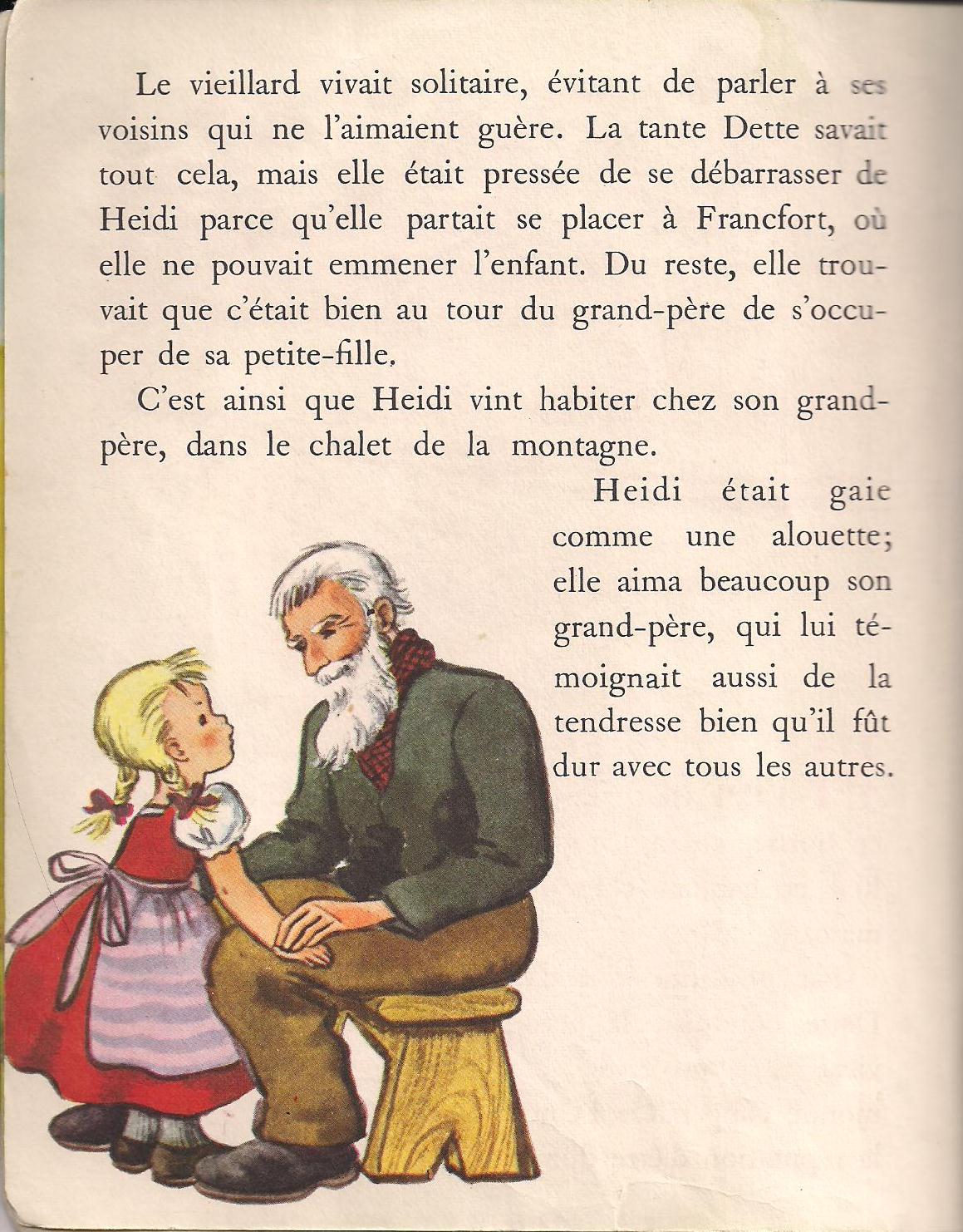
  • About: Heidi, the plucky Swiss girl who goes to live with her grandfather, is one of the most famous characters in kiddie literature. There have been many film interpretations, including a 1937 version with Shirley Temple. This little book, in French and meant for early readers (or those just learning the language), was adapted from Spyri’s 1880 novel. It is highly abbreviated, and features sweet illustrations.
  • Motivation: My mother bought this for her younger sister, who gave it to me years later. It quickly became a favourite. I still have it-although it is rough around the edges from repeated childhood readings. It was, and remains, well-loved.
  • Times Read: Countless
  • Random Excerpt:

    Heidi

    Heidi

  • Happiness Scale: 10++

A Year in Books/Day 151: Roget’s Descriptive Word Finder

  • Title: Roget’s Descriptive Word Finder A Dictionary Thesaurus of Adjectives
  • Author: Barbara Ann Kipfer, Ph.D.
  • Year Published: 2003 (Writer’s Digest Books)
  • Year Purchased: 2003/2004
  • Source: Writer’s Digest Book Club
  • About: The title is its own best review. All I will add is that this book is helpfully broken down into alphabetized categories, from Abandonment to Zoology. It also includes, as an addendum, a Quick Word Finder. As with all good reference books, it is practical and easy to use. Its highly specific nature-the twist of being composed entirely of adjectives and adverbs- is what gives it an edge
  • Motivation: Writers need reference books. Although I use modern technology daily, I am comforted and nourished by old-school reference materials. I love them and, as far as my personal collection goes, I say “the more the merrier.”
  • Times Read: Cover-to-cover: 1/As reference: countless
  • Random Excerpt/Page 1: “This book contains thousands of entries for describing people, places and things with adjectives. It is a combination dictionary and thesaurus exclusively for adjectives and adverbs. Writers can avoid clichés by using fresh, accurate details and by finding the most evocative word or phrase for what they want to describe.”
  • Happiness Scale: 8

A Year in Books/Day 150: Classics of the Silent Screen

  • Title: Classics of the Silent Screen A Pictorial Treasury
  • Author: Joe Franklin
  • Year Published: 1959 (Cadillac Publishing Co., Inc.)
  • Year Purchased: 1990s
  • Source: Antique Barn at the Ohio State Fair
  • About: When this book was published in 1959, silent movies could still be glimpsed in the cultural rear view mirror. The childhood memories of those over 35 would likely have included going to the movies before talkies existed, when the only noise in the theatre came from the accompanying orchestra or fellow patrons’ coughing and munching. Classics of the Silent Screen is split into two parts, with the first half devoted to Fifty Great Films and the second to Seventy-Five Great Stars. The variety of  films and performers is more interesting than the standard roll call usually found in contemporary studies, as the fame of silent movies and their stars has dropped considerably in the last five decades. Franklin is  both a solid film scholar and an unabashedly passionate fan-the ideal combination for a movie writer. The stills that adorn the text are priceless, and add greatly to the book’s appeal. It is well worth the effort to track this one down.

    Betty Bronson

    Betty Bronson (Photo credit: Wikipedia)

  • Motivation: When I bought this book, I hadn’t started writing about silent movies. I was just a young old movie fan turned theatre student, still in the early stages of learning everything I could on the subject. This was one of the first volumes on silent cinema I owned.
  • Times Read: 4 or 5
  • Random Excerpt/Page 72: “Even Peter Pan seemed almost ordinary by comparison when, the following year, director Brenon and star Bronson teamed again to make this second adaptation from Barrie. One of the loveliest and most poignant films ever screened, it was, sad to relate, a flop at the box office-putting an immediate end to further follow-ups.”
  • Happiness Scale: 10

A Year in Books/Day 149: The Oxford Companion to Shakespeare

  • Title: The Oxford Companion to Shakespeare
  • Edited by: Michael Dobson and Stanley Wells
  • Year Published: 2001 (Oxford University Press)
  • Year Purchased: 2001/2002
  • Source: Unknown
  • About: Everything you could want to know about Shakespeare, his works, and his era, this volume is an accompaniment to the Oxford Shakespeare. Dense, detailed and, like any encyclopedia, culled from a diverse, sometimes contradictory set of sources, it is one of the definitive texts on the king of all playwrights. It’s a cornerstone of my Shakespeare collection. Bonus points for the handsome coffee table treatment, complete with beautiful photographs and illustrations.

    English: Title page of Shakespeare's Sonnets (...

    English: Title page of Shakespeare’s Sonnets (1609) (Photo credit: Wikipedia)

  • Motivation: I was that lone teen in high school English Literature class who was thrilled whenever Shakespeare showed up on the syllabus. I grew up to study Shakespearean Theatre (yep, that’s a thing). I’m still passionately keen for the Bard of Avon, whose works comprise one of my favourite linguistic and literary playgrounds.
  • Times Read: Cover-to-cover:1/As resource: countless
  • Random Excerpt/Page 482: “Translation, the rendering of Shakespeare texts into another language, is inalienably part of the process whereby Shakespeare has been, and is being, received in non-English-speaking countries. Hence Shakespeare translation has not only (1) linguistic but also (2) theatrical and cultural-even political-aspects.”
  • Happiness Scale: 10+++

A Year in Books/Day 148: Rebels Pretenders & Impostors

  • Title: Rebels Pretenders & Impostors
  • Author: Clive Cheesman & Jonathan Williams
  • Year Published: 2000 (St. Martin’s Press)
  • Year Purchased: 2001
  • Source: History Book Club
  • About: Rebels Pretenders & Impostors covers all manner of aspirants to various thrones and seats of power throughout the centuries. Armed with intrigue, deceit and delusion (and often shored up by a skewed sense of destiny), the majority of these fake kings, faux queens and misguided rebels ended up on the wrong side of history. Built on strong research and excellent writing ,while remaining fast-paced, this short book resides in the middle ground between popular history and academic study. It is fun food for thought.
  • Motivation: History, how I love thee! Academic or popular, you are both alright in my book.
  • Times Read: 1
  • Random Excerpt/Page 137: “Nor are the Stuarts the only British royal dynasty from whom people claim to descend. The end of the house of Tudor did not inspire either constitutional crisis or a romantic sense of loss in the same way as the events of 1688, but the Tudor monarchs are for many heroic figures, larger than life, loved and hated in equal measure, and with plenty of significance for political and national questions that are still debated. It is not surprising therefore that several individuals have presented themselves as their legitimate descendants.”
  • Happiness Scale: 9

A Year in Books/Day 147: Bare Blass

  • Title: Bare Blass
  • Author: Bill Blass
  • Year Published: 2002 (HarperCollinsPublishers)
  • Year Purchased: 2010
  • Source: My lovely momma
  • About: The loosely structured autobiography of the great American fashion designer is a fun, quick and riveting read. His perspective on national and international society of the mid-to-late 20th-century is considerably more interesting that what I expected. His retelling of his journey from the Indiana boy he never quite left behind to sophisticated man-of-the-world is complex, humorous and compelling, with detours that I never suspected. Yet, his writing voice is exactly what you would expect: barbed, candid, and smooth. By story’s end, it is obvious why he was welcomed with open arms by high society. Bonus: The book includes his apparently famous recipe for meatloaf.
  • Motivation: It was $1.00. My mom knew that I would find it interesting, as I am  a fashion history hobbyist. Well played, Momma. Well played.
  • Times Read: 1
  • Random Excerpt/Page 72: “Actually, what I was shooting for was swagger-a cross between Damon Runyan and the Duke of Windsor, or what fashion editor Sally Kirkland, after seeing my first show, called “the Scarsdale Mafia look.” I loved the expressive masculine style of the thirties. I didn’t give a damn about tastefulness.”
  • Happiness Scale: 8

A Year in Books/Day 146: A Memoir of Jane Austen

  • Title: A Memoir of Jane Austen and Other Family Recollections
  • Author: J.E. Austen-Leigh
  • Year Published: 1870/This Edition: 2002 (Oxford University Press)
  • Year Purchased: 2002/2003
  • Source: Unknown
  • About: J.E. Austen-Leigh was Jane’s nephew, the son of her eldest brother. He was nineteen when his famous aunt died; his impressions of her were published 53 years later. Although there are more scrupulous works of scholarship available, this memoir is the closest we will ever get to the ‘real’ woman (other than her surviving letters and fiction). On the other hand, one can argue that a writer’s works are the best representative of their true self and that everything else-character, mannerisms, speech patterns, habits, loves, hates and proclivities-is the fiction. That is a bit deeper than I want to dive in this mini-review, so hold on to that thought if you’d like; I’m sure I will cover it here some other day. Where were we? Ah, yes! Jane as presented in the bosom of her family hearth and home, by her nephew. As biased as it obviously is, it is a really fantastic book. It is of key importance to Austen scholars and fans alike. This edition also includes reminiscences by her brother Henry and nieces Anna and Caroline, which is a touch that nicely rounds out the portrait of this truly compelling woman.
  • Motivation: I love Jane Austen. Pick your jaw up off of the floor, you must be shocked.
  • Times Read: 2
  • Random Excerpt/Page 1: “More than half a century has passed away since I, the youngest of the mourners, attended the funeral of my dear aunt Jane in Winchester Cathedral; and now, in my old age, I am asked whether my memory will serve to rescue from oblivion  any events of her life or any traits of her character to satisfy the enquiries of a generation of readers who have been born since she died.”
  • Happiness Scale: 10