A Year in Books/Day 159: Emily Brontë

  • Title: The British Writers’ Lives Emily Brontë
  • Author: Robert Barnard
  • Year Published: 2000 (The British Library)
  • Year Purchased: 2012
  • Source: The Book Loft, Columbus, Ohio
  • About: I’m no Brontë virgin. There are many biographies of the famous literary family. I’ve read a lot of them, cut from various cloths. This entry in The British Library Writers’ Lives series is different from any of the others I’ve read. Focusing on middle daughter Emily (she of Wuthering Heights), it completes the feat of being a wonderful introduction to first-timers while bringing something new to the party for veterans. It is steady and insightful without ever resorting to the wild-child mystic trope that has followed Emily’s ghost around for decades. This biography is packed with original photographs, drawings, manuscripts, artwork and letters, which lend it a vivid immediacy that longer works often lack. It is a quick, quick read that you will want to return to time and again.
  • Motivation: I bought this volume to continue my love affair with dead writers and classic literature.
  • Times Read: 1
  • Random Excerpt/Page 38: “There is a touch of cracker-barrel philosopher about this, as if Emily is only happy dealing with strong personal emotion when she can don a Gondal mask as a partial cover for her feelings. Confessional poetry was never to be her forte.”
  • Happiness Scale: 10

A Year in Books/Day 158: Bloomsbury Recalled

  • Title: Bloomsbury Recalled
  • Author: Quentin Bell
  • Year Published: 1995 (Columbia University Press)
  • Year Purchased: 2002/2003
  • Source: Unknown
  • About: The author was the younger son of Vanessa and Clive Bell, two central figures in the Bloomsbury group (which was really just a loose network of friends, family and acquaintances). His aunt was, of course, novelist Virginia Woolf. Bloomsbury Recalled is his brief but excellently engaging memoir of the fascinating adults who formed his parents’ social and professional circles from WWI to the start of the next  great international conflict at the end of the 1930s. The little boy who grew up in a sticky web of conflicting personalities and crossed goals became an accomplished polymath with a distinctive, intelligent and highly amusing voice. His relaxed nature, probing wit and compelling birthright give this book a sparkle that the average Bloomsbury retrospective sorely lacks.
  • Motivation: Bloomsbury? Check. A relatively unbiased insider’s view? Check. Writers, artists and theorists? Oh my! Seriously, this book covers one of my favourite literary periods. That is reason enough.

    English: Portrait of Clive Bell

    English: Portrait of Clive Bell (Photo credit: Wikipedia). The author’s father.

  • Times Read: 3
  • Random Excerpt/Pages 11 & 12 : “I was not alarmed. I was convinced that I was not really consumptive; also, apart from the cough and high temperature, I did not feel at all ill. I enjoyed some fierce arguments with a clergyman, managed to do a little painting, and embarked upon historical research on the principality of Monaco for which I was totally unqualified.”
  • Happiness Scale: 10

A Year in Books/Day 157: Selected Poems & Letters of Emily Dickinson

  • Title: Selected Poems & Letters of Emily Dickinson
  • Editor: Robert N. Linscott
  • Year Published: First edition:1959/This edition: ???? (An Anchor Book)
  • Year Purchased: 2001/2002
  • Source: This was a hand-me-down from a long-time friend.
  • About: If Emily Dickinson was alive and writing today, she would probably blog her poetry under a pseudonym. Since she was born in 1830, she composed reams of golden verse and hoarded them away in dark bureau corners. After she confined herself to home-a situation that was gradual, and not a fierce, sudden statement-she kept up with the outside world via the epistolary arts. Letters make the best (auto)biographies. They are a time capsule, a locus for self-mythology and the only genuine source of a person’s thoughts, feelings and actual opinions. For these reasons, I have long loved volumes with the chutzpah and heart (not to mention access to original material) to combine professional output with personal words. This book is a winner all around.
  • Motivation: Emily Dickinson is one of my preferred poets. Neruda is always and ever in the top spot, but she holds a place of honour in the court.
  • Times Read: Cover-to-cover:2/Random poems: countless
  • Random Excerpt/Page 288: “You wonder why I write so. Because I cannot help. I like to have you know some care-so when your life gets faint for its other life, you can lean on us. We won’t break, Mary. We look very small, but the reed can carry weight.”
  • Happiness Scale: 10+++
    Emily Dickinson

    Ubiquitous Emily Dickinson photo (Photo credit: Wikipedia)


A Year in Books/Day 156: Merchant of Dreams

  • Title: Merchant of Dreams Louis B. Mayer, M.G.M., and the Secret Hollywood
  • Author: Charles Higham
  • Year Published: 1993 (A Laurel Book)
  • Year Purchased: 2000?
  • Source: Unknown
  • About: This is not a nice, unicorns and rainbows biography; nor does it go to great lengths to throw dirt on its subject. Any dirt tossed about was thoroughly earned by the actions of Mayer. It relies heavily on interviews with people who worked with the M.G.M. head  who, although willing to engage in breathtakingly awful antics to further his studio, made an incomparable contribution to Hollywood history. He was one of the leading architects in making it a place of mind, and not just a spot on the map. The mythology that he helped put in place is still screwing with our minds a  century later. Merchant of Dreams also succeeds in humanizing Mayer. Even if he isn’t likable or particularly respectable, he is interesting, controversial  and successful-three qualities that would make him an ideal subject for a biopic of his own.
  • Motivation: My passion for cinema history goes deeper than knowing films and their players; I love the machinations and inner workings of the entire system, down to every behind the scenes contributor–no matter how obscure or powerful. Mayer was definitely the latter.
  • Times Read: 1
  • Random Excerpt/Page 25: “Work, constant work was the Puritan solution for grief, and the young Louis B. Mayer worked desperately hard in the first months of 1914. He was determined to build himself up as a motion picture distributor, taking on all comers.”
  • Happiness Scale: 9

    English: Louis B Mayer at the "Torch Song...

    English: Louis B Mayer at the “Torch Song” movie premiere in Los Angeles, Calif., 1953 (Photo credit: Wikipedia)

A Year in Books/Day 155: The Trouble with Thirteen

  • Title: The Trouble with Thirteen
  • Author: Betty Miles
  • Year Published: 1979 (An Avon Flare Book)
  • Year Purchased: 1986
  • Source: Book fair at an authors conference
  • About: This one is obviously left over from my extreme youth. The plot is simple-the growing pains of two twelve-year-old girls. Even though I was of an age with the heroines, I was intellectually years beyond this book; I read it in half an hour, and immediately returned to better things. I’m fairly certain that the “honesty” of this slim volume was pretty quaint when it was first published in the late 1970s. Even though there is a quote from the Christian Science Monitor on the cover comparing Miles to Judy Blume, that is some real nonsense. However, I bought (and kept) it for a very specific reason. See below to find out why. Continue reading

A Year in Books/Day 154: The Portable Dorothy Parker

  • Title: The Portable Dorothy Parker
  • Author: Dorothy Parker (with an introduction by Brendan Gill)
  • Year Published: This Edition-1976 (Penguin Books)
  • Year Purchased: 2005
  • Source: The Book Loft, Columbus, Ohio
  • About: I’d like to think that Dorothy Parker needs no introduction, so I am not writing one. She engenders fierce loyalty in readers or, for those of a different mind-set, strong distaste. If you are known to curl up your tongue at her superior wit, and excellent writing, well, at least we know up front that we are from two different planets. Continue reading

A Year in Books/Day 153: Tennyson’s Poems

  • Title: Tennyson’s Poems
  • Author: Alfred, Lord Tennyson
  • Year Published: Unknown, but it is fairly old (Thomas Y. Crowell & Co.)
  • Year Purchased: 1990s
  • Source: Columbus Public Library sale
  • About: How many times have you had your metaphorical heart broken? One, three, five? How many times, in the quickening of your pain, has someone attempted to dress your ripening wound with the phrase  ‘Tis better to have loved and lost than never to have loved at all?  Although it has been degraded from over-use to the level of cheap platitude, it actually represents two lines from Tennyson’s IN MEMORIAM A.H.H. , which took the poet 17 years to write. A one-time Poet Laureate, his work remains popular. This book is a complete edition, and features a striking blue cover with an embossed Art Noveau design. The poet’s name on the spine is on a  deep gold background. It is one of the prettiest volumes in my library.
  • Motivation: The opportunity to get poetic kicks on the cheap, in the form of a lovely old volume, made this too good to pass up.
  • Times Read: Cover-to-cover: 1/Random poems: countless
  • Random Excerpt/Page 17: “Vex not thou the poet’s mind /With thy shallow wit:/Vex not thou the poet’s mind; For thou canst not fathom it.”
  • Happiness Scale: 8
    Carbon print of Alfred Lord Tennyson, 1869, pr...

    Carbon print of Alfred Lord Tennyson, 1869, printed 1875/79 (Photo credit: Wikipedia)


A Year in Books/Day 152: Heidi

  • Title: HEIDI FILLE DES MONTAGNES
  • Author: Adapted from the novel by Johanna Spyri
  • Illustrations: Steffie Lerch
  • Year Published: 1969 (Gautier-Languereau-Paris)
  • Year Purchased: 1970
  • Source: My mom brought this back from an extended stay in France, well before I was born.
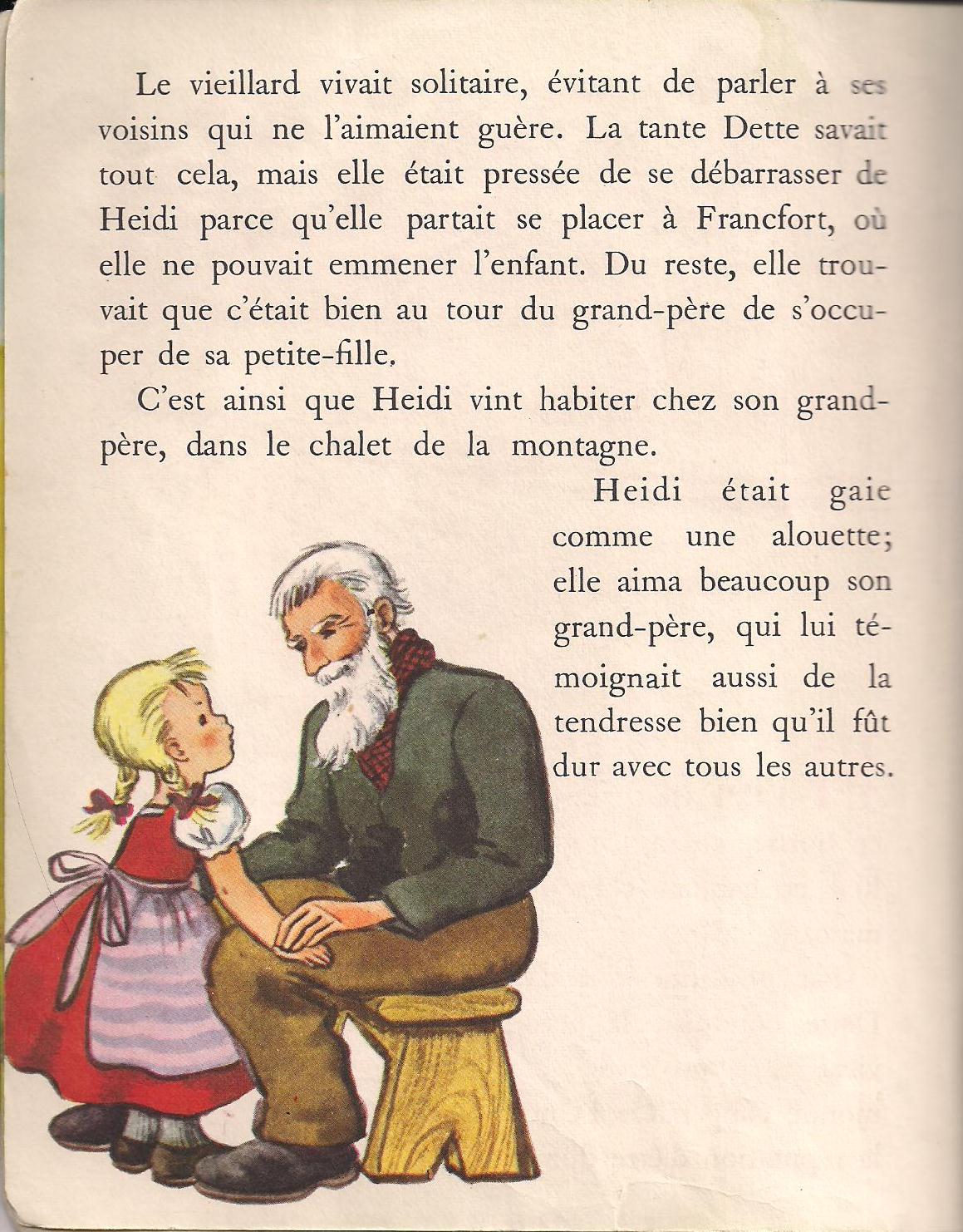
  • About: Heidi, the plucky Swiss girl who goes to live with her grandfather, is one of the most famous characters in kiddie literature. There have been many film interpretations, including a 1937 version with Shirley Temple. This little book, in French and meant for early readers (or those just learning the language), was adapted from Spyri’s 1880 novel. It is highly abbreviated, and features sweet illustrations.
  • Motivation: My mother bought this for her younger sister, who gave it to me years later. It quickly became a favourite. I still have it-although it is rough around the edges from repeated childhood readings. It was, and remains, well-loved.
  • Times Read: Countless
  • Random Excerpt:

    Heidi

    Heidi

  • Happiness Scale: 10++

A Year in Books/Day 151: Roget’s Descriptive Word Finder

  • Title: Roget’s Descriptive Word Finder A Dictionary Thesaurus of Adjectives
  • Author: Barbara Ann Kipfer, Ph.D.
  • Year Published: 2003 (Writer’s Digest Books)
  • Year Purchased: 2003/2004
  • Source: Writer’s Digest Book Club
  • About: The title is its own best review. All I will add is that this book is helpfully broken down into alphabetized categories, from Abandonment to Zoology. It also includes, as an addendum, a Quick Word Finder. As with all good reference books, it is practical and easy to use. Its highly specific nature-the twist of being composed entirely of adjectives and adverbs- is what gives it an edge
  • Motivation: Writers need reference books. Although I use modern technology daily, I am comforted and nourished by old-school reference materials. I love them and, as far as my personal collection goes, I say “the more the merrier.”
  • Times Read: Cover-to-cover: 1/As reference: countless
  • Random Excerpt/Page 1: “This book contains thousands of entries for describing people, places and things with adjectives. It is a combination dictionary and thesaurus exclusively for adjectives and adverbs. Writers can avoid clichés by using fresh, accurate details and by finding the most evocative word or phrase for what they want to describe.”
  • Happiness Scale: 8

A Year in Books/Day 150: Classics of the Silent Screen

  • Title: Classics of the Silent Screen A Pictorial Treasury
  • Author: Joe Franklin
  • Year Published: 1959 (Cadillac Publishing Co., Inc.)
  • Year Purchased: 1990s
  • Source: Antique Barn at the Ohio State Fair
  • About: When this book was published in 1959, silent movies could still be glimpsed in the cultural rear view mirror. The childhood memories of those over 35 would likely have included going to the movies before talkies existed, when the only noise in the theatre came from the accompanying orchestra or fellow patrons’ coughing and munching. Classics of the Silent Screen is split into two parts, with the first half devoted to Fifty Great Films and the second to Seventy-Five Great Stars. The variety of  films and performers is more interesting than the standard roll call usually found in contemporary studies, as the fame of silent movies and their stars has dropped considerably in the last five decades. Franklin is  both a solid film scholar and an unabashedly passionate fan-the ideal combination for a movie writer. The stills that adorn the text are priceless, and add greatly to the book’s appeal. It is well worth the effort to track this one down.

    Betty Bronson

    Betty Bronson (Photo credit: Wikipedia)

  • Motivation: When I bought this book, I hadn’t started writing about silent movies. I was just a young old movie fan turned theatre student, still in the early stages of learning everything I could on the subject. This was one of the first volumes on silent cinema I owned.
  • Times Read: 4 or 5
  • Random Excerpt/Page 72: “Even Peter Pan seemed almost ordinary by comparison when, the following year, director Brenon and star Bronson teamed again to make this second adaptation from Barrie. One of the loveliest and most poignant films ever screened, it was, sad to relate, a flop at the box office-putting an immediate end to further follow-ups.”
  • Happiness Scale: 10