
I dream of a world where people care enough about writers to give them silly, unnecessary and catchy nicknames. Move aside JLo and LiLo, because here comes JAust (pronounced joust, because it just sounds better). Are you sick of Brangelina and, Lord help us, Kimye? Fear not, because SylT is here to make it all better. (For the record: I refuse to acknowledge the talented but dickish Ted with more than a perfunctory T.) I could do this all day (and probably will in some future post, because this is kind of fun, yes?) but I’ll stop after one more, the subject of this piece: KathMans.
This modernist writer deserves all of the accolades and absurd nicknames (because in this day even superficial media interest=power) that we can throw at her. In the short story world, she’s just that important. There are writers who are responsible for changing their genres, whether or not you are influenced by their work. For something as relatively modern as the short story, there is a direct and easily traceable lineage back to the beginning of the form. Katherine Mansfield, and her considerable contribution, resides here in boldface.
The demands of a short story are entirely different from a novel, which is given hundreds of pages to form, grow and breathe. The former has limitations as to space, character development, description and pace; the latter can afford both to be more direct AND more obscure, as needed or decreed by the author. While those aforementioned limitations are exhausting, they are also exhilarating: the challenges they afford a dedicated practitioner are an adrenaline junkie’s dream. Your multitasking skills become enviable. You learn to rise to the occasion repeatedly, often dozens of times within a few pages. Condensing everything into a fraction of the space of a novel-whilst simultaneously tossing dead weight out the window (or into the trash can)-is tough work, and intensely rewarding. Perhaps you are wondering why so much effort is poured into such a low word count. Here’s why: the result of the two forms is expected to (and should) be the same for the reader. Word count doesn’t matter; emotional and intellectual response is the desired outcome of any reading experience.
KathMans (yes, I’m running with this for the duration of the article) devoted her entire career to mastering and expanding the short story, which she did by turning the focus of an already narrow form inward. She explores the interior of her characters as if they are new worlds waiting to be mapped, with the firm understanding that psychological interest is modern and thus, in a quiet way, revolutionary. Nearly a century later, this approach still has the ability to astound. The world is, after all, one where ruckus and action reign; where faster is better; where snappy dialogue or bloody violence is allowed to stand in for anything more subtle, and real. Not much has changed in life-or fiction.
Miss Brill, first published in November 1920, comes to us in less than five pages. She is, remarkably, as fully formed in that scant space as she could be were she allotted 50 times the length. She is alive, with full flesh and pumping heart; a silly, hopeful, pathetic, nearly invisible English language teacher living on the French Riviera. We feel for her, if only because we are too embarrassed to laugh at her the way the careless young couple does. We know that her Sunday in the park, watching an open-air concert, is the highlight of her week. Every week. She wears her specially-purchased fox fur stole and, sitting in her regular spot, sets out to enjoy the spectacle of humanity that parades and swarms around her. Stroking her fox head, her idea of engaging in conversation is to eavesdrop on those sitting within ear shot.
“They did not speak. This was disappointing, for Miss Brill always looked forward to the conversation. She had become really quite expert, she thought, at listening as though she didn’t listen, at sitting in other people’s lives for just a minute while they talked round her.”
Miss Brill-confined, claustrophobic, lonely-makes you uncomfortable. Witnessing her feeble attempts at glamour and camaraderie-at inclusion-is to walk away feeling ashamed, almost dirty. The only available recourse is to not feel sorry for her, even when she is deflated and delusional; for doing so would strip her of the only dignity she possesses. The ending slaps you, leaving you slightly winded and curious, antsy for her well-being and sanity. All accomplished in just a few lines.
In my mini-review of The Garden Party and Other Stories, which appeared here a couple of weeks ago, I highlighted the following passage:
“On her way home she usually bought a slice of honey-cake at the baker’s. It was her Sunday treat. Sometimes there was an almond, sometimes not. It made a great difference. If there was an almond it was like carrying home a tiny present-a surprise-something that might very well not have been there. She hurried on the almond Sundays and struck the match for the kettle in quite a dashing way.”
The first few words of the next paragraph-the story’s last-change everything:
“But today she passed the baker’s by”.
The ending flies downhill from there; it is over just a few breaths later. The emotional crash-such a believable turnaround from the beginning of a few pages earlier-is stunning. In many ways, KathMans is at her best here: she delineates one woman’s interior world, and her stance to the real one around her, on a small-scale, grandly. Beautifully written, with no fat, everything is to the point yet complex. There are only five, short lines of dialogue. They are enough to change the pace, and move the story along, before falling back into the descriptive silence that shatters the course of the piece-and one sad woman’s carefully constructed fantasy.
It is the work of a powerful writer, and one fully at home in the medium she helped change.
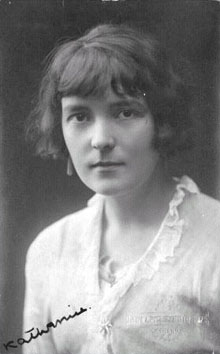
“You can call me KathMans.”
 A Small Press Life: Books. Art. Writing. Life. Tea.
Oh your first paragraph cracked me up! SylT! Woot! Great review. 5 lines of dialogue in a complete story (even a short one) is no easy task. I will have to get a collection and read it …
LikeLike
Thanks! I’m sick of these silly celebrity nicknames, especially the newly-coined KIMYE. I thought, why not do it with writers? It was a lark (leading up to the serious review of KathMan’s short story) but I really want SylT to happen! It needs to be a thing.
You should definitely read some Katherine Mansfield stories. Short fiction was her only medium, and that devotion and study and work really shows. I think that a great experiment would be to read one of her collections-or at least a few stories-and then read some other short stories. You will really notice her strengths and methods even more that way.
LikeLike
Hi, I love the voice and the humor in your blog! I also love short stories and of course Irwin Shaw! Thank you for the follow! Well wishes with your writing, I think you’re talented!
LikeLike
Thank you so much for the kind words. And it was my pleasure to follow your lovely blog!
LikeLike
Pingback: Happy 125th Birthday, Katherine Mansfield! | A Small Press Life